
Your needs, this model
Does it fit your priorities?
Is the probe specifically intended for thin food checks?
The maker identifies a 1.7 mm needle probe and names thin-mass foods as an intended application. Correct placement and food-specific checking guidance still matter.
Explore this need in the finder →Does the Auto-Cal name establish an adjustment I can perform?
Not from this sheet. It names the feature but does not give the exact user adjustment procedure, so that requirement remains unconfirmed.
Explore this need in the finder →Can I measure a food target above 311°F with this documented version?
No. The stated measurement range ends at 311°F. Do not borrow the wider range of another FlashCheck model.
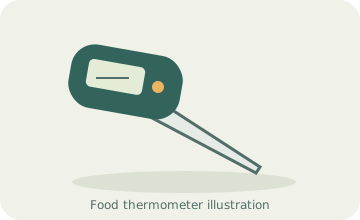
Explore this need in the finder →The 11063 FlashCheck is a spot-check instrument whose original specification gives a clear reason to consider it: a small needle tip for checking thin foods, paired with a larger attached display. It is worth comparing for that specific task rather than treating the FlashCheck name as a guarantee that every model has the same range or controls.
The needle tip is the relevant design detail
DeltaTRAK identifies a 1.7 mm needle tip on a 99 mm stem and names thin foods as an intended application. That describes the actual sensing tool more usefully than a generic fast-reading claim.
A thin item still needs correct probe placement. Reaching the relevant internal location matters more than touching the outer surface and immediately accepting a number. For different foods and shapes, follow the applicable checking guidance and the exact operating instructions.
Read the performance conditions
The sheet's response claim is less than five seconds for a specified temperature transition from 32°F to 77°F. That condition should travel with the claim. It is not an independently measured promise for moving directly from room temperature into every hot food.
The accuracy specification also has a temperature band and a percentage condition. Do not reduce it to a universal one-degree guarantee across the complete measuring range. Display resolution, update interval and accuracy are separate properties.
A direct local check
The instrument has its own jumbo display and indicates Fahrenheit or Celsius. Its role is a person making a direct reading at the food. No separate handheld receiver, phone arrangement or remote alert is established by the original sheet.
That can be preferable when the task is an inspection or a final check rather than following a long cooking process. If the user needs to leave a probe installed and walk away, a documented monitoring arrangement is the appropriate comparison.
Auto-Cal needs the actual instructions
The model name and feature list mention Auto-Cal, and the sheet describes factory calibration. Those statements identify features to investigate, but they do not explain an adjustment procedure the user can perform.
Before changing a reading, obtain the exact guide for this version. A calibration check, a factory certificate and a user-adjustable indication are not interchangeable. Do not press an assumed button sequence from another FlashCheck model or correct a reading according to a preferred cooking result.
Know the range and care boundary
This documented version measures from-40°F to 311°F. If your task requires a higher internal-food reading, it is outside that range regardless of the temperature a different model may advertise.
The sheet describes a sealed IP56 construction and a 1.5 V supply. It does not give dishwasher permission, an oven-safe body rating or a complete cleaning procedure. Obtain the matching care instructions instead of equating a water-resistance rating with every possible washing method.
The useful fit is therefore a deliberate needle-probe spot-check routine with clearly stated measuring limits. The source is the original 11063 manufacturer sheet. For cooking targets, consult current food-specific guidance; a fast reading is useful only when the right place and requirement are being checked.
Key details at a glance
| Documented spot-check use | Yes |
|---|---|
| Included food probes | 1 |
| Fahrenheit display | Yes |
| Celsius display | Yes |
| Measuring without batteries or charging | No |
| Documented food range minimum | -40°F |
| Documented food range maximum | 311°F |
| Probe length | 99 mm |
| Probe-tip diameter | 1.7 mm |
| Manufacturer accuracy claim | Manufacturer specifies ±1°F from 14–194°F or±1%, whichever is greater; response claim is less than5s only for 32–77°F transition. |
| Power arrangement | Maker specifies1.5 V supply; exact cell type not established by this sheet. |
| Care notes | Sheet statesIP56 sealed construction; it does not grant dishwasher permission. |
Use the exact model’s instructions for operating limits, supplied equipment and version differences.
Sources for this assessment
Find a thermometer for your cooking routine.
Compare the documented measuring setups, included equipment and features that matter to you.