
Your needs, this model
Does it fit your priorities?
Can I hold a reading when I cannot see the display while inserting the probe?
Yes. HOLD retains the reading for inspection after the check. Clear it before measuring another place.
Explore this need in the finder →Will the pen measure food at 20°F?
That is outside its documented 32–392°F range. Choose a thermometer with an established below-freezing range.
Explore this need in the finder →Can I leave this splash-guard pen in a closed oven?
No. The maker says its body is not heat-resistant. The splash guard does not change that restriction.
Explore this need in the finder →The Escali DHP2 Digital Pen Thermometer is a compact tool for checking food by hand. Its strongest practical feature is display hold: you can make a measurement where the screen is awkward to see, then bring the tool into view. It is not a monitor that stays in a closed oven.
A pen shape with a useful cover
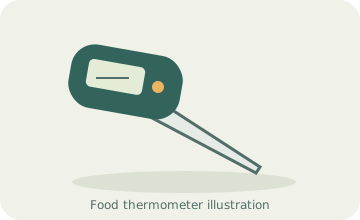
The manufacturer specifies a three-inch probe and a pocket-sized body. The protective sheath has two jobs: covering the stem for storage and serving as a handle extension. That gives it a different handling arrangement from a folding thermometer, where the probe swings out of the body.
A pocket clip and lanyard are described on the maker's product page. These are carrying conveniences, not extra sensing equipment. Do not assume that the support heading “DHP2 / DHP2-2” means two temperature probes are included. The actual instructions describe one pen, one stem and one display.
The step-down stainless-steel probe is intended for internal measurements. Its quoted length tells you the stem's size, not the minimum insertion depth or a guarantee that it will work well in every thin food. Choose a placement that puts the sensing part in the food rather than against the pan or through the other side.
What display hold changes
Pressing HOLD retains the displayed measurement. That helps when the angle needed to insert the probe is different from the angle needed to read it. Make the check, hold the reading and then inspect it where the display is visible.
A retained reading is a record of that check. It is not evidence that the food is still at the same temperature after the probe has moved. Release the hold and make a fresh measurement when checking another part or another item. This distinction becomes useful when moving between several pieces in the same pan.
The original instructions show separate on/off, unit and hold controls. Fahrenheit and Celsius selection therefore does not require the battery-compartment switch used on the DH1. If you share a thermometer with someone who prefers the other unit, that is a more tangible advantage than an unverified speed comparison.
Range and splash protection
The documented measuring range is 32°F to 392°F, or 0°C to 200°C. A below-freezing measurement is outside that stated range. Likewise, the upper measuring number is not permission to expose the body to oven heat.
The maker calls the cover over the controls a splash guard. The exact care page still says the unit is not waterproof and must not be submerged. Plan on wiping it clean rather than dropping it into a sink, even though the front surface is designed to be easy to wipe.
Care instructions also prohibit leaving the thermometer inside a closed oven because its body is not heat-resistant. A pen can measure a hot food briefly without being an oven-safe leave-in instrument. Select the measuring routine first; the fact that both products have steel probes does not make them interchangeable.
One replaceable cell, no remote receiver
The manufacturer lists one LR44 battery. The documented arrangement is the pen's own display and integral probe. You do not need an app account to read it, but this is not a battery-free mechanical tool.
No exact response-time or accuracy figure is established in the original material reviewed here. The step-down probe is described as helping measurements, but that does not justify inventing a two-second result or calling it more accurate than another pen.
Choose it for the angle of the check
DHP2 makes sense when compact storage, accessible buttons and retaining a hard-to-see reading matter. It is less useful when you want an alarm to call you, continuous oven monitoring or a verified below-freezing range. A cabled leave-in unit solves the monitoring problem; a handheld tool with an explicitly wider range solves a different one.
Check the model and its supplied instructions when buying. DHP2 and DHP2-2 share an official support section, but a retailer's suffix alone does not establish a second probe, a revised measuring range or a different heat rating.
Key details at a glance
| Documented spot-check use | Yes |
|---|---|
| Documented leave-in monitoring | No |
| Included food probes | 1 |
| Fahrenheit display | Yes |
| Celsius display | Yes |
| Measuring without batteries or charging | No |
| Documented food range minimum | 32°F |
| Documented food range maximum | 392°F |
| Probe length | 76.2 mm |
| Power arrangement | One LR44 cell; local unit and HOLD controls. |
| Care notes | Damp-cloth cleaning; splash guard is not waterproofing. Do not immerse or leave inside a closed oven. |
Use the exact model’s instructions for operating limits, supplied equipment and version differences.
Sources for this assessment
Find a thermometer for your cooking routine.
Compare the documented measuring setups, included equipment and features that matter to you.