
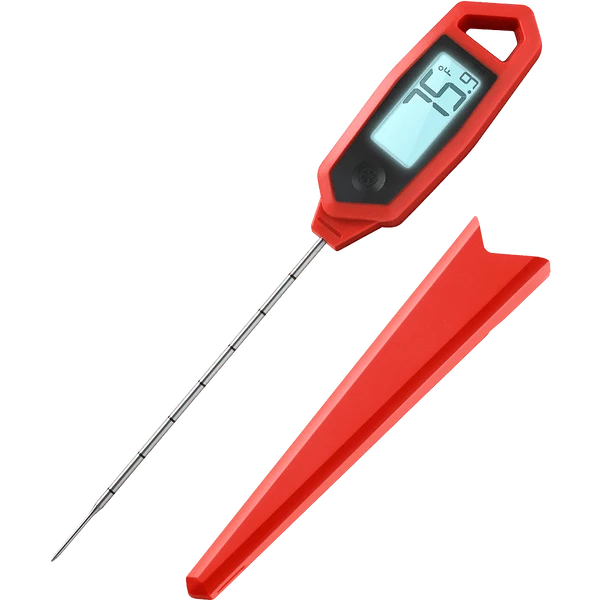
Your needs, this model
Does it fit your priorities?
I need a lit local display and characters I can turn for an awkward measuring angle. Does PT18 fit?
Yes. It has a button-activated backlight and manually selectable readout orientation; that is different from automatic orientation sensing.
Explore this need in the finder →Can it flash at a chosen temperature while I watch carryover cooking outside the oven?
Yes. Its limited attended monitoring routine uses a silent flashing display. It cannot be left in an oven and does not provide a remote alert.
Explore this need in the finder →Can I adjust the calibration myself rather than only check it?
Yes. The original guide describes an adjustment mode after an appropriate ice-bath check. It warns against unnecessary adjustment, and a battery change erases it.
Explore this need in the finder →The Lavatools PT18 is a fixed-probe thermometer for a cook who wants more control at the point of measurement: an illuminated readout, manually selectable display orientation and a genuine calibration adjustment. It also has a silent target-temperature indication for limited attended monitoring. It is not an oven-safe substitute for a leave-in barbecue probe.
Why choose a fixed stem?
A fixed stem gives you a direct point-and-read routine without unfolding a joint. That can make sense when you take repeated readings at a work surface and have a safe place to set the tool between checks. The useful comparison is not simply fixed versus folding, but whether the controls and display make your particular sequence easier.
PT18 provides a front-button backlight and a rear control that changes the readout orientation. This is a manual choice, rather than a promise that the characters rotate automatically whenever you turn your hand. Set the display so that you can read it comfortably without twisting the sensing tip out of its intended position.
The maker gives a typical two-to-three-second response. Treat that as a manufacturer claim and still wait for a stable reading. A quick number is valuable only when the sensing tip is in the food you mean to measure, rather than against bone, a pan or a very different-temperature surface.
The silent alarm is a specific kind of help
The PT18 manual describes setting a target temperature with its two buttons. When the target is reached, the display flashes. That is a visual, silent indication. It does not establish an audible alarm that will call you from another room, and the instrument has no documented phone or handheld-receiver route in this configuration.
Lavatools describes limited leave-in uses such as monitoring carryover cooking or measuring oil. This is useful when the thermometer remains in an appropriate position and you are watching the display. It does not override the manual’s prohibition on leaving the instrument in an oven or placing the probe directly over fire.
For a roast already removed from the heat, a local visual target can answer a different question from continuous oven monitoring. Choose a cabled leave-in model or a heat-rated wireless probe if you need the instrument to remain in the cooking enclosure. A measuring range extending to a high temperature does not establish that the whole PT18 housing can tolerate that surrounding heat.
Calibration that actually adjusts the reading
PT18’s calibration feature is a genuine adjustment process, not just an instruction to check the thermometer in ice. The manual explains how to enter the adjustment mode after preparing a proper ice bath. It also warns against changing calibration unnecessarily and notes that the saved adjustment is erased after a battery change.
That makes calibration useful for a user who can carry out a careful procedure and retain a record of it. It can become a disadvantage if different people adjust the tool casually after inconsistent tests. Start with correct placement and a properly prepared reference check; changing the indication is not a remedy for every unexpected cooking result.
The product reference gives a measuring range of -40°F to 482°F, with its ±0.9°F accuracy claim limited to -4°F through 302°F. Keep those two ranges separate. Neither a narrow-band specification nor one ice-point check establishes identical accuracy at every possible temperature.
Water resistance has a cleaning boundary
The user guide describes IPX7 water resistance and brief submersion, but specifically advises against dishwasher cleaning. Follow its handling and body-cleaning instructions rather than treating the IP rating as permission for a hot wash cycle or prolonged soaking. The electronics and stem need to be cared for as the actual assembled tool.
The CR2032 battery is replaceable, and low power has a display indication. Because calibration adjustment is lost after replacement, anyone relying on that adjustment should account for the battery change before returning the tool to service. The advertised battery-life figure is a maker estimate, not an ownership result measured here.
The practical fit
Choose PT18 when a local illuminated display, manually rotated characters and user calibration address real difficulties in your cooking routine. Its silent visual target can help with limited monitoring outside the oven, provided you remain present and follow the operating restrictions. Choose another documented system for an audible remote alert, rotisserie work or a probe that must tolerate sustained oven or grill surroundings.
Key details at a glance
| Documented spot-check use | Yes |
|---|---|
| Documented leave-in monitoring | Yes |
| Included food probes | 1 |
| Fahrenheit display | Yes |
| Celsius display | Yes |
| Illuminated instrument readout | Yes |
| Rotating displayed characters | Yes |
| Dishwasher-safe food probe | No |
| User calibration adjustment | Yes |
| Measuring without batteries or charging | No |
| Documented food range minimum | -40°F |
| Documented food range maximum | 482°F |
| Probe-tip diameter | 1.6 mm |
| Manufacturer accuracy claim | Manufacturer: ±0.9°F only from -4°F to 302°F. |
| Power arrangement | One CR2032 cell; a battery change erases the user calibration adjustment. |
| Care notes | IPX7 brief submersion does not permit a dishwasher or prolonged soaking; no oven or direct fire. |
Use the exact model’s instructions for operating limits, supplied equipment and version differences.
Sources for this assessment
Find a thermometer for your cooking routine.
Compare the documented measuring setups, included equipment and features that matter to you.