
Your needs, this model
Does it fit your priorities?
Can I check both a pan surface and the food itself?
Yes. The maker identifies separate surface and internal-food contact probes. Choose the appropriate one; a pan measurement is not the food’s internal temperature.
Explore this need in the finder →Do two probes mean I can leave it in two foods at once?
No such arrangement is documented. The two sensors serve different checks, and a two-food monitoring setup is not established.
Explore this need in the finder →Does it work without batteries or charging?
No. The maker lists an included AAA battery. A fold-away design is not a passive dial thermometer.
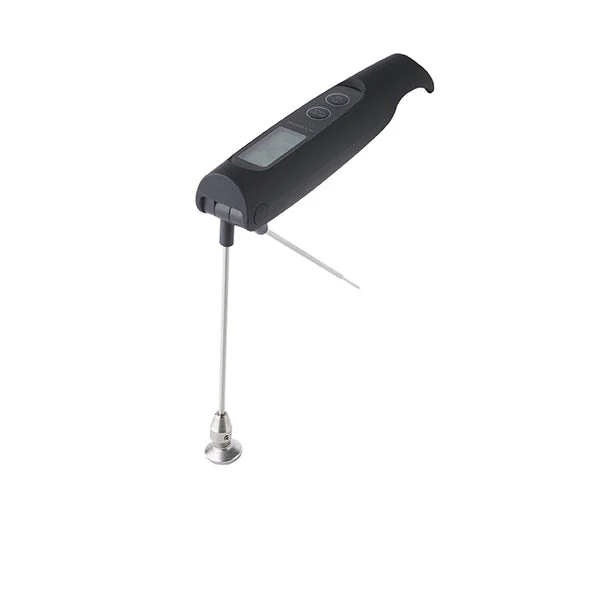
Explore this need in the finder →M°Control is useful when your cooking question has two stages: is the cooking surface ready, and what is happening inside the food? Mastrad gives those jobs separate contact probes in one fold-away tool. That is a more specific reason to consider it than simply wanting a thermometer with two probes.
Start with the surface, then change the question
A pan or griddle reading helps you understand the surface you are about to cook on. The food probe answers a different question after the food has been added. A hot pan does not demonstrate that the center of a piece of food has reached the temperature you intended.
For example, someone preparing several items on a griddle may want a surface check before starting, followed by individual internal checks as the food cooks. This is a hands-on sequence of measurements. It is not the same as installing two probes in separate foods and following both readings throughout a long cook.
Two sensing tools, one practical distinction
The exact maker description identifies a surface contact probe and an internal-food probe, both based on typeK thermocouple sensors. That gives a clear reason to choose the appropriate end for each task. The design should not be described as two interchangeable food probes merely because two sensing components are present.
If you need simultaneous meat and chamber monitoring in a closed oven, look for a leave-in configuration that documents that arrangement. A cooking-surface check before starting is not a continuous chamber-temperature sensor beside the food.
Keep the display in your working routine
M°Control presents readings on its own display and the probes fold away for storage. It suits a cook who is present at the stove or grill and wants to inspect a reading directly. No phone, internet gateway or separate handheld receiver is established by this product reference.
That simplicity can be useful when a measurement is only one step in a larger preparation task. The tradeoff is that a glanceable local tool does not provide evidence of a temperature-triggered alert sent elsewhere. If leaving the cooking area is the main need, choose a documented monitoring system instead.
Read the stated range correctly
The manufacturer gives a measurement range from-58°F to 572°F and lists an included AAA battery. The range describes measurement capability; it does not authorize putting the whole display body into an oven or leaving it against a hot cooking surface.
The page also uses a half-degree precision description. That is not treated here as an independently verified, whole-range accuracy result. When comparing instruments, distinguish a display increment, a manufacturer's accuracy statement and an actual test under stated conditions.
Before choosing it
Choose M°Control if the surface-versus-food distinction matches the way you cook and you are comfortable making individual checks. Confirm the applicable operating and cleaning instructions for the exact unit, especially which parts may be wet and how the sensors must be positioned.
A conventional single food probe is simpler if you never need surface contact readings. A cabled or wire-free leave-in monitor is a better category if you want to follow a roast without repeatedly returning with a handheld tool. The useful choice is the supported routine rather than the highest apparent probe count.
This assessment uses the exact Mastrad US product reference. For safe food targets, use current food-specific guidance; a product's broad measuring range is not a cooking recommendation.
Key details at a glance
| Documented spot-check use | Yes |
|---|---|
| Included food probes | 1 |
| Measuring without batteries or charging | No |
| Documented food range minimum | -58°F |
| Documented food range maximum | 572°F |
| Power arrangement | Included AAA battery; the second sensing tool is for surfaces, not a second simultaneous food measurement. |
Use the exact model’s instructions for operating limits, supplied equipment and version differences.
Sources for this assessment
Find a thermometer for your cooking routine.
Compare the documented measuring setups, included equipment and features that matter to you.