
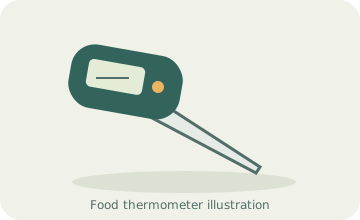
Your needs, this model
Does it fit your priorities?
Does this tool provide a true internal-food contact reading?
Yes. Use the folding K-type probe for an internal measurement. The IR channel remains a separate surface-reading mode.
Explore this need in the finder →Does a continuous-scan Lock make it a leave-in oven monitor?
No oven-safe monitoring configuration is established by that feature. The Lock description concerns measuring modes on the handheld instrument.
Explore this need in the finder →Can a factory calibration statement confirm user adjustment?
No. The maker states factory calibration, but this source does not establish an adjustment procedure the user can perform.
Explore this need in the finder →The TCT303F is a handheld instrument for two distinct jobs: infrared surface checks and direct internal-food checks with its folding probe. It is a useful category to compare when both tasks matter. If your only requirement is to leave a sensor in a roast and receive an alert elsewhere, it is the wrong documented workflow to assume.
Choose the sensing method deliberately
The folding K-type contact probe is the component that measures within food. The IR channel samples a surface. Using both methods during one task can be helpful, but their readings are not interchangeable.
For instance, a surface scan can identify an area to investigate before taking a contact reading. It does not establish the temperature at the center of a thick piece of food. When an internal value is required, use the actual probe and the applicable placement instructions.
The two temperature ranges differ
Metris gives the contact probe a range extending to 626°F, while the IR range ends at 572°F. Read the relevant channel's specification rather than applying the larger number to everything the instrument does.
Those are measurement ranges, not a whole-instrument oven rating. A handheld body's electronics and display need their own operating conditions. The ability to display a hot contact reading does not mean the tool can remain inside a hot cooking chamber.
Continuous scanning is not continuous cooking monitoring
The maker describes maximum, minimum and Lock modes for measurements. A Lock that continues taking readings is different from a heat-approved leave-in probe arrangement with its display outside the cooker.
This matters when comparing feature lists. A user wanting to follow a long cook should ask where the sensor stays, where the display sits and whether the exact arrangement is approved for that surrounding heat. The word continuous alone does not answer those questions.
Local warnings and everyday visibility
The instrument includes temperature-zone warning LEDs and selectable Fahrenheit or Celsius units. Those are local aids for a person looking at the device. They do not establish a smartphone connection, a separate receiver or notifications delivered away from the measurement location.
Use any zone indication alongside the current requirements for the actual food and process. A generic indicator cannot account for every cooking instruction, holding requirement or relevant rest period. It assists interpretation rather than choosing the correct rule for you.
Accuracy and care need their own boundaries
The maker gives different accuracy statements for contact and infrared use, and the IR claim applies over a stated temperature band. A specification for one method should not be presented as proof of identical performance across the other method's full range.
The page also mentions factory calibration and an IP65 rating. Neither establishes a user-adjustment procedure or dishwasher permission. Confirm the exact cleaning and care instructions before deciding how to maintain the food-contact part.
A sensible shortlist role
Choose this type of tool for deliberate spot checks when having both methods avoids carrying separate instruments. A simpler food-probe thermometer is enough if you never need surface measurements. A documented leave-in system is the relevant alternative when you need ongoing viewing and temperature alarms.
The basis is the exact TCT303F maker reference, without importing features from TCT703F. For cooking decisions, consult current food-specific guidance rather than treating the instrument's full range as a recommended target.
Key details at a glance
| Documented spot-check use | Yes |
|---|---|
| Included food probes | 1 |
| Fahrenheit display | Yes |
| Celsius display | Yes |
| Measuring without batteries or charging | No |
| Documented food range minimum | -67°F |
| Documented food range maximum | 626°F |
| Manufacturer accuracy claim | Maker contact-probe claim ±0.9°F/0.5°C; IR claim ±1.8°F only 32–150°F. No independent validation claimed. |
| Power arrangement | Two included AAA batteries; a folding contact food probe and a separate IR mode. |
Use the exact model’s instructions for operating limits, supplied equipment and version differences.
Sources for this assessment
Find a thermometer for your cooking routine.
Compare the documented measuring setups, included equipment and features that matter to you.