
Your needs, this model
Does it fit your priorities?
Can it measure inside the food as well as scan a surface?
Yes. The folding K-type contact probe measures internal food temperature; the separate IR channel measures surfaces. Use the contact probe for an internal check.
Explore this need in the finder →Does the laser let me measure a roast’s center without inserting anything?
No. The infrared channel is a surface measurement. The internal reading requires the actual contact probe.
Explore this need in the finder →Can it alert me at a temperature target I choose?
The source establishes fixed local temperature-zone indicators, but not a user-selected target alert. That alarm requirement remains unconfirmed.
Explore this need in the finder →The TCT703F Food Inspector combines a folding food-contact probe with an infrared surface instrument. It makes sense for someone who needs both kinds of check and understands why they answer different questions. The important distinction is the sensing method, not the presence of a laser.
Use the food probe for an internal reading
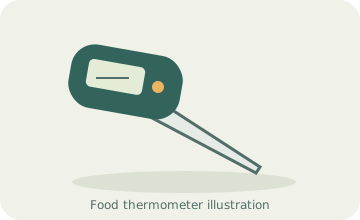
Metris identifies a 2 mm needle-tipped K-type probe that folds into the side when stored. This is the component used to measure within the food. The infrared channel measures an external surface and cannot see the center of a roast.
A practical sequence might begin with a surface scan to locate an area worth checking, followed by a contact measurement where an internal reading is needed. Do not treat a cool-looking or hot-looking surface as proof that the interior has the same temperature.
The laser is an aiming aid
The maker specifies an 8:1 distance-to-spot relationship for the IR channel and a multi-point aiming pattern. Those features help describe the area being sampled. They are not a way to focus a measurement through the outer layer of food.
Moving farther away changes the sampled surface area. For a small target, check that the intended area fills the instrument's measurement spot. The contact mode avoids that particular optical issue, but it has its own placement requirements.
Read the correct channel and units
The product reference describes Fahrenheit and Celsius selection and separate IR and contact displays. Confirm which reading you are interpreting before recording it. A remembered surface value and a live internal value can be very different even during the same cooking task.
The stated contact-probe range is broad, but a measurement range is not permission to heat the entire instrument to that temperature. The maker gives a much lower operating range for the body. This is a handheld checking tool, not an established leave-in oven setup.
What the temperature-zone indicators do
The Food Inspector includes local GO/NO-GO visual temperature-zone indicators. They can help a user notice that a displayed reading has entered a programmed zone. They do not replace choosing the correct current requirements for the food or process being assessed.
Nor do they establish a custom alarm sent to a phone or remote receiver. If you need a notification while elsewhere, compare a monitor with the viewing and alert route explicitly documented. A local colored indicator solves a different problem.
Accuracy statements remain channel-specific
Metris publishes separate accuracy descriptions for the K-type probe and the IR channel, with temperature-band conditions for infrared measurement. A favorable number from one channel should not be attached to every reading the instrument can display.
This review does not report an independent speed, accuracy or durability test. It also does not turn a food-equipment listing into a claim that every cooking outcome is safe. The instrument still needs correct use, care and an appropriate interpretation of its readings.
Who should compare it?
Consider this model if your work involves deliberate spot checks of both surfaces and internal food. A simple internal-food pen may be easier if you never need IR, while a leave-in alarm system is more appropriate for following a cook continuously.
The exact maker page uses TCT703 in its heading and TCT703F in the product description; this reference follows that documented family naming. The Metris product information is the technical basis. Use current food-specific safety guidance for cooking targets rather than relying on a generic color-zone label.
Key details at a glance
| Documented spot-check use | Yes |
|---|---|
| Included food probes | 1 |
| Fahrenheit display | Yes |
| Celsius display | Yes |
| Measuring without batteries or charging | No |
| Documented food range minimum | -76°F |
| Documented food range maximum | 662°F |
| Probe-tip diameter | 2 mm |
| Manufacturer accuracy claim | Maker states ±1.8°F/±1°C for the contact K-probe; the IR channel has separate temperature-band conditions. |
| Power arrangement | Two AAA batteries; IR surface and folding K-type food probe are distinct measurement modes. |
Use the exact model’s instructions for operating limits, supplied equipment and version differences.
Sources for this assessment
Find a thermometer for your cooking routine.
Compare the documented measuring setups, included equipment and features that matter to you.