
Your needs, this model
Does it fit your priorities?
Can I carry it in a protective pocket sheath?
Yes. The exact maker record includes a sheath and pocket clip for the food-preparation instrument.
Explore this need in the finder →Can the user adjust its calibration?
The maker explicitly supplies a user calibration nut. Obtain and follow the applicable checking/adjustment instructions.
Explore this need in the finder →Is it a suitable choice for a 500°F food-measurement requirement?
No. Its stated measurement range ends at 220°F; that limit is not an oven or body heat rating.
Explore this need in the finder →A pocket tool for straightforward food checks
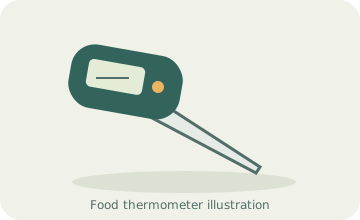
FGTHP220C makes sense when your main requirement is an instrument you can keep protected in a pocket and use for a local food-preparation check. The sheath and clip are meaningful features in that routine: the probe can be stored without leaving a bare point loose among other tools. Its user calibration nut is another useful distinction when you want an instrument that can be checked and adjusted through the appropriate procedure.
It is less suitable if the real problem is forgetting to return to the cooker. The exact current maker record does not establish a leave-in alarm configuration, a handheld radio receiver or a phone connection. Choose a monitor for that task rather than assuming a pocket food thermometer can take it on.
The useful range has a definite upper limit
The Rubbermaid Commercial US record gives a 0–220°F measurement range. That is a clear buying boundary if you need to measure something hotter. It also should not be confused with the safe ambient temperature for the complete instrument. A reading scale describes measurements, not permission to leave the entire tool in a cooking enclosure.
For a normal food check, place the sensing region where it can answer the question you care about. In a thick piece, a reading close to a surface can differ from the centre. In a thin piece, sufficient insertion may be difficult. Obtain the applicable model directions for the required sensing depth rather than assuming every steel stem senses at exactly its point.
Adjustment is useful only with a good reference check
A calibration nut is a real user-adjustment feature, but it does not tell you to turn the instrument until it agrees with a convenient kitchen estimate. Use the proper reference preparation and the maker’s applicable method. If a check seems far wrong, inspect the instrument and the test arrangement before adjusting it.
This distinction is important for a tool carried from task to task. A bump, a storage problem and a poorly prepared check can all cause concern for different reasons. Repeatedly adjusting without understanding the cause can hide a problem rather than solve it. The presence of a nut is not an independently verified accuracy score.
Think about visibility and cleaning as everyday tasks
A pocket instrument needs to be easy enough for you to read in the positions where you actually use it. If you routinely work in dim light or at an awkward angle, make a documented illuminated or rotating readout a separate requirement. Those features are not established for this exact record simply because other thermometers offer them.
Keep the food-contact portion clean before each appropriate use and protect the sheath from food residue. A protective cover is a storage feature, not a sanitising device. The current product record does not give a complete washing method, so check the applicable instructions before immersing it or placing it in a dishwasher. Stainless construction alone does not establish either permission.
When to put it on the shortlist
Consider FGTHP220C for local checks within its documented range when pocket storage and a user calibration feature are useful to you. Its exact US maker record is stronger evidence of identity than a similar regional listing or a generic photograph. The page’s shipping-case measurements are not used here as the individual tool’s size.
For continuous roast monitoring, an audible finish target, multiple foods at once or a high-temperature measurement beyond the scale, choose a differently documented configuration. This thermometer’s value is a simple, portable checking job. Matching that job is more useful than adding connected or oven-safe features that its actual record does not establish.
Key details at a glance
| Documented spot-check use | Yes |
|---|---|
| Included food probes | 1 |
| Fahrenheit display | Yes |
| User calibration adjustment | Yes |
| Documented food range minimum | 0°F |
| Documented food range maximum | 220°F |
| Power arrangement | Local pocket instrument; current source does not establish any connected alert system. |
Use the exact model’s instructions for operating limits, supplied equipment and version differences.
Sources for this assessment
Find a thermometer for your cooking routine.
Compare the documented measuring setups, included equipment and features that matter to you.