
Your needs, this model
Does it fit your priorities?
Can I watch one roast on a local leave-in dial without batteries or charging?
Yes. 5939N documents a passive dial routine and oven/grill leave-in use. Position it correctly and read it safely.
Explore this need in the finder →Will moving the slide marker make it alert me at that temperature?
No. The marker is a visual reference, not a temperature-triggered alarm. You must look at the dial.
Explore this need in the finder →Can I use the same dial to measure food at 50°F?
No. The documented scale starts at 120°F. Choose a tool with an actual range that includes your required measurement.
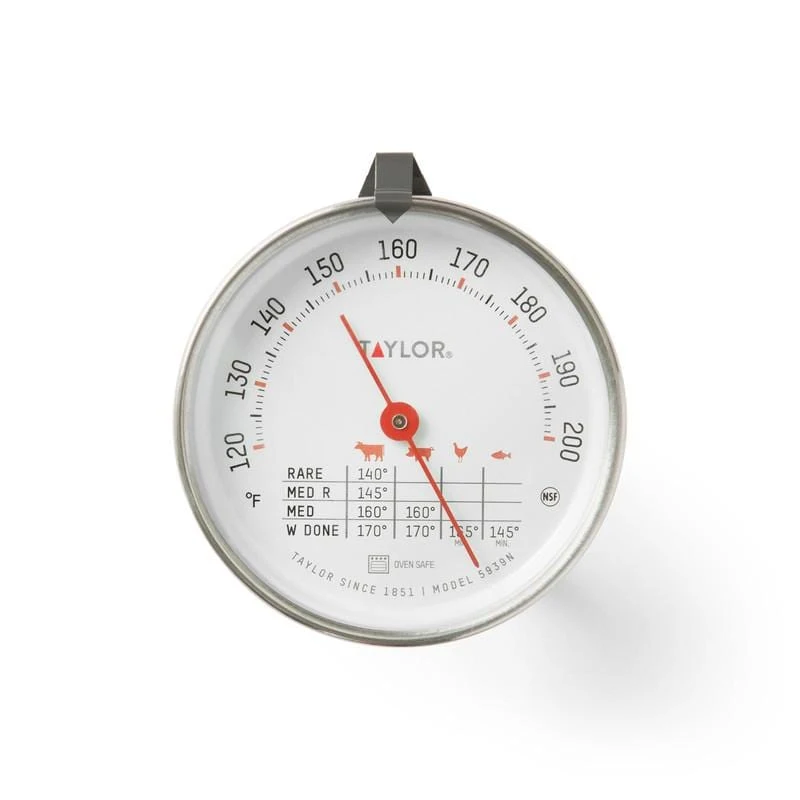
Explore this need in the finder →The Taylor 5939N is a large-dial leave-in meat thermometer for someone who wants to look at a roast’s internal temperature directly, without a phone or electronic receiver. Its three-inch face and movable reference marker make sense for a slow, attended cooking routine. The marker is a visual reminder, not a temperature-triggered alarm.
A dial you watch during the cook
Taylor explicitly permits this model to remain in an oven or grill during use. That separates it from the brand’s 9840 and 9832 digital spot-check tools, whose instructions prohibit leave-in cooking. Choose according to that actual operating difference rather than assuming every metal-stem thermometer can do the same job.
The 5939N operating card has the user insert the stem into the meat, position the slide reference and watch the indication. There is no phone to pair or receiver to carry. This can be attractive if you want a self-contained mechanical reading and are comfortable returning to inspect it.
The tradeoff is visibility and attention. A dial inside a cooking enclosure does not follow you to another room. Position it so that you can read it safely and handle hot parts with suitable protection. Convenience depends on where the food and dial sit, not only on how large the printed numbers are.
Positioning is more important than the printed food labels
The original card describes inserting the thermometer into the thickest part, with its stated positioning relative to the center, while avoiding bone, fat and gristle. Follow the model’s insertion instructions rather than applying a short-tip digital pen’s procedure to this longer-stem dial.
Consider the food you normally cook. A larger roast gives you a different placement opportunity from a thin fillet or a small piece in a shallow pan. If your main job is checking a thin food at several points, a suitable spot-check thermometer is the more useful comparison. The 5939N is presented as a leave-in meat tool, not an instant-reading pen.
The face and older packaging include food-temperature references. Use current food-specific safety guidance for the target, rather than treating printed historical doneness labels as a complete modern safety chart. The thermometer measures temperature; it does not decide the correct target or required rest time for every food.
A limited measuring range is a real distinction
The current manufacturer reference gives a scale from 120°F to 200°F. That covers a particular part of the cooking process. It is not a wide-range instrument for checking refrigerator temperatures, an ice bath or every stage of candy making.
Match the actual required measurement to that scale before buying. A tool that is useful while a roast approaches its intended result may be unsuitable for another kitchen task at a much lower or higher temperature. A broad category such as “cooking thermometer” does not remove those limits.
Also keep the scale separate from the surrounding-heat rating. Permission to use the model in an oven does not mean 200°F is a stated maximum oven setting, and the food-measuring range does not establish a higher numeric ambient limit. This assessment does not invent that missing specification.
The sliding marker cannot call you
Moving the reference indicator gives your eye a place to compare the pointer. It does not program an electronic target or cause a beep. This is a useful fit for a user who wants a simple visual check; it fails a requirement for an alert at a temperature you choose.
For that second routine, compare a documented leave-in electronic model with a local alarm or a separate receiver. Choose the alert destination you actually need. A passive dial and a wireless receiver can both follow cooking, but they demand different kinds of attention from the cook.
Care and the final choice
The exact 5939N card specifies hand washing, with no immersion or dishwasher cleaning. Do not assume a stainless-steel appearance makes it a dishwasher-safe utensil. Allow for safe removal and handling after cooking, then follow the maker’s care instructions.
Choose 5939N when a battery-free, self-contained leave-in dial and a visual reference are enough for your roast routine. Choose another tool for a temperature alarm, remote viewing, a wider measuring range or thin-food spot checks. Its value is a clear, limited job performed in the documented arrangement, without an unnecessary claim that it replaces every thermometer in the kitchen.
Key details at a glance
| Documented leave-in monitoring | Yes |
|---|---|
| Included food probes | 1 |
| Fahrenheit display | Yes |
| Dishwasher-safe food probe | No |
| Measuring without batteries or charging | Yes |
| Documented food range minimum | 120°F |
| Documented food range maximum | 200°F |
| Power arrangement | Passive mechanical dial; the documented measuring routine requires no battery, charging or external powered unit. |
| Care notes | Handwash only; do not immerse or put in a dishwasher. Handle the hot stem and dial with suitable protection. |
Use the exact model’s instructions for operating limits, supplied equipment and version differences.
Sources for this assessment
Find a thermometer for your cooking routine.
Compare the documented measuring setups, included equipment and features that matter to you.