
Your needs, this model
Does it fit your priorities?
Can I change the stem position to reach food more comfortably while taking a local spot check?
Yes. The 9832 instructions document pen and plunger positions. Its insertion and stabilization requirements still apply.
Explore this need in the finder →Can I leave it in the food while a roast cooks?
No. The original card explicitly says it is not oven-safe and cannot remain in food during cooking.
Explore this need in the finder →Does the pivoting stem mean the temperature characters automatically turn toward me?
No such rotating-readout feature is established. The documented adjustment changes the stem position, while HOLD keeps a measured value for viewing.
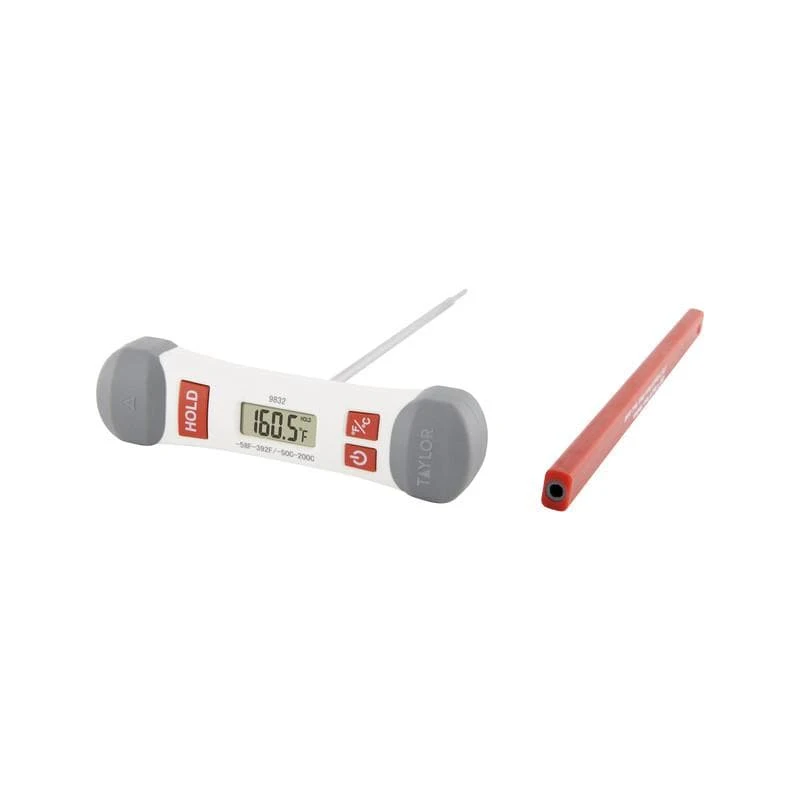
Explore this need in the finder →The Taylor 9832 is an instant-read thermometer whose stem moves between a pen-like position and a plunger-like position. Choose it when reaching the food comfortably is your main difficulty. The moving stem changes how you hold the instrument; it does not establish a rotating digital readout or oven-safe leave-in operation.
Two stem positions for different approaches
Taylor’s original instruction card describes the pen position for thinner foods and the plunger position for roasts and poultry. The practical value is access. You can choose a grip that lets the tip reach the intended interior location without forcing your wrist into the same position for every dish.
That makes sense for a cook alternating between a shallow pan and a larger roast. The right angle can make the check easier to carry out deliberately, but it does not change where the food needs to be measured. Avoid choosing an insertion point merely because that is where the display is easiest to see.
The card specifies at least one inch of stem insertion and avoiding bone, fat and gristle. For a thin food, consider the direction of entry and whether the sensing section can actually sit inside the food. A fine-tipped probe still needs correct placement; a small puncture is not proof that any superficial reading will be useful.
Hold can help, provided you know what is held
The HOLD function locks a reading on the display after removing the thermometer. This can be useful if the measuring position is awkward but the value is easier to read once the tool is withdrawn. Keep track of whether the display is showing a stored value or a new live measurement.
If you are checking several pieces, do not accidentally carry the held value from one check into the next. Reset the routine deliberately and wait for the new reading to stabilize. A hold function is a convenience for viewing a result, not a way to skip the next measurement.
Likewise, changing the stem angle is different from turning the displayed characters. If your essential requirement is an illuminated readout that automatically faces you, compare an explicitly documented rotating-display model. This assessment does not infer that feature from the adjustable stem.
It must be removed during cooking
The 9832 instruction card is explicit: it is intended for periodic checks and is not oven-safe or permitted to remain in food during cooking. Follow the removal and checking sequence in the actual instructions. Do not treat the high measuring range as a temperature rating for its display housing.
This is a useful distinction when planning a roast.9832 can help you check an internal temperature at a chosen moment. It is not a replacement for a leave-in probe that stays connected to a separate display and alerts you when a selected target is reached.
Choose according to whether you want to visit the food for each check or follow it continuously. Trying to make a spot-check tool perform the second job defeats the purpose of its actual operating restrictions.
Range, care and battery handling
The manufacturer gives a measuring range of -58°F to 392°F. That is useful coverage for comparing the tool against a required food temperature, but it does not establish a response time, accuracy tolerance across the whole range or a surrounding-heat limit for leave-in use. No such independent test results are claimed here.
The current product reference identifies a 1.5 mm step-down tip and one LR44 battery. The small tip may be attractive when you want a narrow point of entry, but the required insertion depth still matters. Keep the instrument’s form and its measurement procedure together when deciding whether it suits the food you usually check.
Taylor specifies hand washing and prohibits immersion and dishwasher cleaning. The hot metal parts also need appropriate handling after use. An adjustable joint adds a reason to follow the supplied cleaning instructions carefully rather than treating the assembled tool like a plain stainless-steel utensil.
Who should buy it?
Choose 9832 if a changeable grip and a held reading solve a real access problem in your kitchen. A simpler fixed-stem pocket tool may be enough when access is already easy. A documented rotating-display thermometer is a better comparison for readout orientation, and a true leave-in system is the better fit for uninterrupted cooking-temperature monitoring. Those alternatives address different needs rather than making the movable stem a universal advantage.
Key details at a glance
| Documented spot-check use | Yes |
|---|---|
| Documented leave-in monitoring | No |
| Included food probes | 1 |
| Dishwasher-safe food probe | No |
| Measuring without batteries or charging | No |
| Documented food range minimum | -58°F |
| Documented food range maximum | 392°F |
| Probe-tip diameter | 1.5 mm |
| Power arrangement | One LR44 battery. |
| Care notes | Hand wash only; no immersion or dishwasher. Not oven-safe and not left in food during cooking. |
Use the exact model’s instructions for operating limits, supplied equipment and version differences.
Sources for this assessment
Find a thermometer for your cooking routine.
Compare the documented measuring setups, included equipment and features that matter to you.