
Your needs, this model
Does it fit your priorities?
Can I check food with a small local thermometer in Fahrenheit or Celsius?
Yes. 9840 supports a local spot check and selectable Fahrenheit/Celsius. Follow its insertion instructions and wait for a stable reading.
Explore this need in the finder →Can I leave 9840 in a roast while it cooks in the oven?
No. The current instruction sheet prohibits oven or grill leave-in use because the plastic parts can be damaged.
Explore this need in the finder →Does a screen that updates each second prove a one-second temperature response?
No. Update frequency and settling time are different. Taylor’s instructions still require waiting for stabilization.
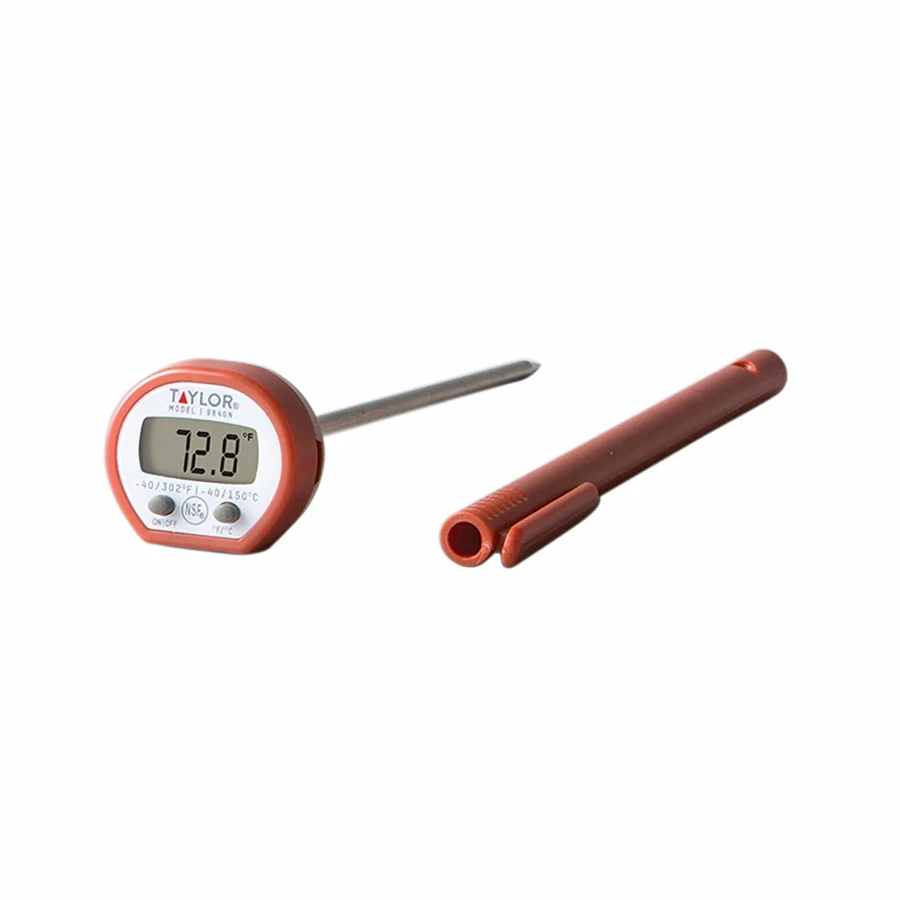
Explore this need in the finder →The Taylor 9840 is a small fixed-stem thermometer for taking a temperature, waiting for the reading to settle and removing the probe. Choose it when you want a basic local readout and a protective pocket case. Choose a different kind of tool when the job requires a probe to remain in an oven and call you at a target temperature.
What its simple display is good for
The 9840 has a compact LCD, an on/off control and Fahrenheit/Celsius selection. That is enough for a deliberate check at the cooking surface without setting up a phone or a separate receiver. Its case and clip make sense for a person who wants to store the probe between checks rather than leave it in the food.
The useful routine is to decide where the food needs checking, insert the sensing part correctly and read a stable value. Checking several portions means repeating that process for each one. One reading at an easy-to-reach edge should not be treated as a complete assessment of every portion or every part of a large roast.
The current instructions specify at least one inch of stem insertion and avoiding bone, fat and gristle. That is an important practical constraint for small or thin foods. Do not borrow a different thermometer’s shorter insertion requirement merely because both products are described as instant-read.
An updated number is not necessarily a settled number
Taylor says the digital readout updates every second. That describes how frequently the display changes, not proof that a probe moved from room temperature to hot food has reached its final reading in one second. The instructions explicitly tell the user to wait for stabilization.
This distinction matters when comparing basic pocket thermometers with products that claim a particular response time. Look at what the specification actually describes. If you remove the probe as soon as a plausible number appears, you may be acting before the measurement settles, even though the display has already updated.
A cook who is comfortable taking a moment for each check may prefer this uncomplicated routine. Someone who needs a larger illuminated display at awkward angles should compare the actual visibility features of another model rather than assume a small LCD will be equally comfortable in every position.
Keep it out of the cooking enclosure
The manufacturer’s current instruction sheet says not to leave the 9840 in an oven or grill during cooking, because the plastic parts can be damaged. Remove the food as directed for the check, remove the thermometer afterwards and return the dish to cooking if necessary.
That is a different job from continuous monitoring. There is no documented remote viewing arrangement or user-selected temperature alarm in the reviewed configuration. If you want to follow a roast without reopening the cooking enclosure for each measurement, choose an actual leave-in system with a suitable probe and alert route.
The protective case is for storage and portability. It does not convert the assembled instrument into an oven-safe probe, and a familiar brand name does not erase the handling instructions for this specific model.
Battery replacement and condition
The updated 9840 sheet specifies an LR44 cell and describes opening the housing carefully during replacement so the wires are not pulled apart. That is more involved than casually popping a battery into a large external door. Follow the exact instruction sheet and check the instrument before returning it to normal use.
Take care with the small battery when storing spares or changing it. The measurement routine depends on a working powered display, so this model does not meet a requirement for battery-free operation. A mechanical dial is a different comparison for that need.
The buying decision
Choose 9840 for basic spot checking in either display unit, with a local number and a pocket-storage arrangement. The documented upper measuring limit is 302°F; the lower-bound wording differs between the current retail description and the food-service catalog, so do not rely on this assessment for an exact freezing-range requirement.
For most buyers, the decisive question is simpler: do you want to check and remove, or monitor continuously?9840 fits the first routine. It should not be sold as a substitute for a leave-in alarm thermometer or as a one-second response instrument simply because the screen updates every second.
Key details at a glance
| Documented spot-check use | Yes |
|---|---|
| Documented leave-in monitoring | No |
| Included food probes | 1 |
| Fahrenheit display | Yes |
| Celsius display | Yes |
| Measuring without batteries or charging | No |
| Documented food range maximum | 302°F |
| Power arrangement | One LR44 cell; follow the updated housing-opening instructions without pulling the internal wires. |
| Care notes | Follow current Taylor care instructions; do not leave the unit in an oven or grill. |
Use the exact model’s instructions for operating limits, supplied equipment and version differences.
Sources for this assessment

Find a thermometer for your cooking routine.
Compare the documented measuring setups, included equipment and features that matter to you.