
Your needs, this model
Does it fit your priorities?
Can I check food and then move the display into view?
The hold function can freeze a reading, but take the reading with the probe correctly placed first.
Explore this need in the finder →Can I correct a small ice-point error myself?
Yes. The original F05 instructions describe a LOCK-button calibration sequence; follow the complete ice-bath procedure.
Explore this need in the finder →Can it stay in a roast during cooking?
No. Its original precautions explicitly describe temporary handheld use and forbid leaving it in cooking food.
Explore this need in the finder →A useful pen when you want a reading, not a cooking dashboard
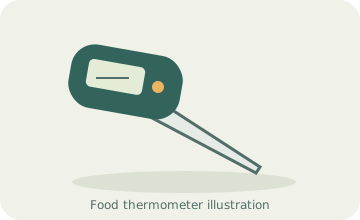
F05 is best understood as a handheld check-and-remove thermometer. You unfold the probe, place it in the food and read the result locally. Its light and hold control help with the moment of reading; they do not turn it into a system that supervises cooking while you walk away. That simple distinction prevents a disappointing purchase if your real problem is remembering to check a roast later.
Consider a person checking chicken pieces on a tray. The useful routine is to check representative thick positions, investigate an unexpectedly low reading and clean the probe appropriately between raw and cooked food. The tool can move from piece to piece. A single reading cannot establish the temperature of the whole tray, and a frozen number cannot show what happened after you removed the probe.
Use hold after measuring, not instead of measuring
The original instructions describe a hold button and a short-duration backlight. Hold is useful when you cannot comfortably see the display at the insertion angle. Let the sensor give you the reading you intend to keep, then freeze it and bring the display into view. Pressing hold too early can preserve a transitional reading just as faithfully as a settled one.
A folding probe also offers a compact storage routine. Keep the hinge and food-contact metal clean before folding it against the body. Make the Fahrenheit/Celsius choice before cooking, and check that the single AAA battery is ready. These small tasks matter more in daily use than a claim that every kitchen needs the same model.
An actual user-calibration procedure
The original two-page F05 instructions include an ice-bath adjustment sequence using the LOCK control. That is more useful evidence of user calibration than a vague statement that a thermometer was calibrated at a factory. Follow the full sequence and prepare the check correctly; a badly made reference bath can lead you to adjust a working instrument in the wrong direction.
A one-point adjustment also needs reasonable expectations. It does not prove perfect performance across every temperature, nor does it repair a damaged probe. If readings become erratic after heat exposure or a fall, investigate the cause instead of repeatedly forcing the display to agree with a convenient number. The maker’s accuracy statement applies to its stated band, and is not an independent result from our own testing.
Why the range is not permission to leave it in an oven
The manual gives a broad food-measurement range while explicitly prohibiting oven use and leaving the instrument in food during cooking. Those statements describe different things: the probe can briefly measure hot food, but the handheld body is not a remote oven display. Remove the complete tool after each check. If you need a reading throughout the cook, choose a documented leave-in probe with its electronic display placed as instructed.
The same care applies to washing. A water-protection rating is not a substitute for the written cleaning directions. F05’s original precautions prohibit a dishwasher and immersion. Build a hand-cleaning routine around the actual instructions and let a hot probe cool before touching it. A tool that is easy to read still needs to be clean before it touches ready-to-eat food.
Where it fits in a shortlist
Choose F05 when local checks, a light, a hold function and a documented user adjustment are the features you will actually use. Do not assume that folding means automatic character rotation, or that an electronic display means a target-temperature alarm. Those needs require separate evidence.
This review concerns the TempPro-labelled F05 original instructions. It does not borrow specifications from TP19H, TP620 or another similarly shaped thermometer. For a straightforward check-and-remove job, the relevant question is how comfortably you can place, read, clean and store the probe. For unattended monitoring, choose a different operating configuration from the outset.
Key details at a glance
| Documented spot-check use | Yes |
|---|---|
| Documented leave-in monitoring | No |
| Included food probes | 1 |
| Fahrenheit display | Yes |
| Celsius display | Yes |
| Illuminated instrument readout | Yes |
| Dishwasher-safe food probe | No |
| User calibration adjustment | Yes |
| Measuring without batteries or charging | No |
| Documented food range minimum | -58°F |
| Documented food range maximum | 572°F |
| Probe length | 109 mm |
| Manufacturer accuracy claim | Maker manual: ±0.9°F at 32–212°F. No independent timing or accuracy test claimed. |
| Power arrangement | One AAA; folding on/off, ten-second backlight and hold button. |
| Care notes | Do not put in oven or dishwasher, or leave in cooking food; wipe/hand clean as instructed and do not immerse. |
Use the exact model’s instructions for operating limits, supplied equipment and version differences.
Sources for this assessment
Find a thermometer for your cooking routine.
Compare the documented measuring setups, included equipment and features that matter to you.