
Your needs, this model
Does it fit your priorities?
Can one probe follow a roast and the cooker temperature together?
Yes. This TP960 arrangement has an internal-food sensor and a separate ambient sensor in the same probe. It measures one food and its environment, not two separate foods.
Explore this need in the finder →Can I use it on a rotisserie without a probe cable?
The current exact TP960 maker page explicitly includes rotisserie use. Insert the probe beyond its notch, stay within the food and ambient limits, and keep the booster close enough to maintain connection.
Explore this need in the finder →Can I read the food temperature on the booster without my phone?
No numerical booster display is documented for this edition. The 2026 manual does describe an audible booster target alarm, which is different from a readable stand-alone temperature screen.
Explore this need in the finder →One roast and its surroundings, without a probe cable
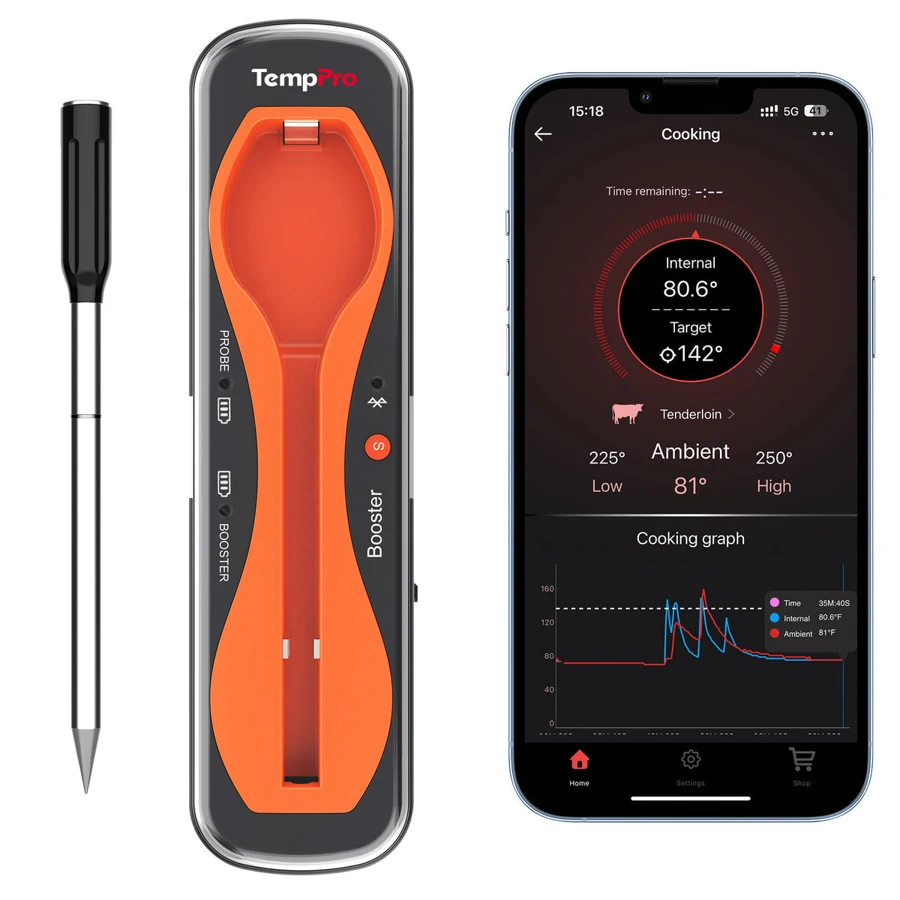
The TempPro TempSpike CORE TP960 is for a cook who wants a probe to stay in one piece of food while a phone shows both its internal temperature and the surrounding cooking temperature. There is no cable running from the food to an outside display. The included booster receives the probe signal and is also the charging and storage base.
Its two sensors do not mean two foods. One measures the food around the inserted section; the other measures the environment at the exposed end. That combination can be useful for a roast or a smoking session, but it cannot independently tell you when two different pieces of meat are ready.
Choose it for a phone reading
The current TP960 page describes an app-based reading, and the booster does not have a numerical temperature screen. The 2026 CORE instructions do describe a target alarm sounding from the booster as well as the app. Hearing an alarm at the cooker is useful, but it is different from glancing at the actual food temperature without a phone.
Set up the app and notifications before starting the cook. The original instructions mention adding the device to TempPro cloud, but the documented radio arrangement is Bluetooth. This review does not turn that cloud wording into a promise that the included kit can be checked from anywhere over the internet.
The internal and exposed limits are different
The documented food range is 14°F to 212°F. The ambient sensor range is 14°F to 572°F. The higher endpoint belongs to the exposed cooking environment, not to a food sensor that measures internal temperatures up to 572°F. When choosing a thermometer for a particular measurement, compare the requirement with the correct range.
The insertion notch is equally important. The metal section must go deeply enough into the food for the notch to be covered. This protects the intended arrangement inside the meat; it is not an optional mark to ignore for a thin piece. Consider whether the food can accommodate the probe before choosing a cable-free system.
Rotisserie use is a real reason to avoid a cable
The manufacturer explicitly includes rotisserie use for the TP960. This is a practical difference from a wired probe connected to a stationary outside unit. Rotation need not twist a food-probe cable, but the probe still has to be inserted correctly and kept within its heat limits. A wire-free design removes one constraint, not every operating constraint.
The same maker reference includes ovens, grills, smokers and pans. Keep the booster protected outside the cooking environment and follow the instructions for the actual setup. Do not assume that a magnet allowing attachment near an appliance makes the booster safe inside it.
Connection and charging are part of preparation
A closed metal cooker and other obstacles can reduce the usable radio connection. The manual specifically warns that the probe-to-booster link can become much shorter when the food is inside a metal cooking appliance. Position the booster close enough and check the connection indication in the place where you will actually cook.
Both the probe and booster contain rechargeable batteries. Charge them before use and keep the probe's charging contacts clean. The included USB cable does not eliminate the need to check battery state before a long session. Published battery-duration and range figures are manufacturer specifications, not guarantees from independent testing here.
Care and the edition to compare
The current product page explicitly permits dishwasher cleaning of the probe. The 2026 foldout also says to let the probe cool before rinsing and to remove buildup from its charging contacts. Those instructions do not apply to washing the booster as though it were the food probe.
Choose this TP960 edition when one food plus ambient monitoring, phone viewing and a genuinely cable-free setup suit your needs. Choose a numerical receiver or local-display model if you want a readable number without a phone. Check the actual model and supplied instructions when comparing older ThermoPro packaging with current TempPro CORE references; a familiar model number alone does not prove every edition has the same controls.
Key details at a glance
| Documented leave-in monitoring | Yes |
|---|---|
| Included food probes | 1 |
| Fahrenheit display | Yes |
| Celsius display | Yes |
| Dishwasher-safe food probe | Yes |
| Measuring without batteries or charging | No |
| Documented food range minimum | 14°F |
| Documented food range maximum | 212°F |
| Whole probe surrounding-heat maximum | 572°F |
| Probe length | 132 mm |
| Manufacturer accuracy claim | English 2026 manual lists ±1.8°F from 14°F to 212°F and otherwise ±2%; no independent accuracy or radio-range testing. |
| Power arrangement | Rechargeable probe and booster; included USB cable. Booster can sound an alarm but has no numerical temperature screen. |
| Care notes | Current maker page explicitly permits dishwasher cleaning of the probe;2026foldout says cool before rinsing and clean charging contacts. Keep the booster out of probe-washing procedures. |
Use the exact model’s instructions for operating limits, supplied equipment and version differences.
Sources for this assessment
Find a thermometer for your cooking routine.
Compare the documented measuring setups, included equipment and features that matter to you.