
Your needs, this model
Does it fit your priorities?
Can I use a simple local thermometer without a phone?
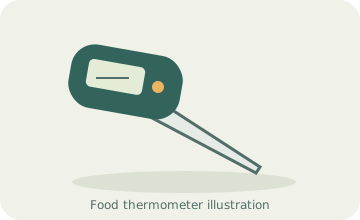
Yes. This exact TP-03 edition uses an ON/OFF button, a Fahrenheit/Celsius button and a folding probe for hand-held checks.
Explore this need in the finder →Can it stay in a roast while the oven runs?
No. Both the helpful hints and care section say it is hand-held equipment and must not remain inserted during cooking.
Explore this need in the finder →Does the word TP03 prove it has the backlight in a newer shop listing?
No. This 2017 original establishes the two-button configuration, not a later TP03B or another listing’s illumination feature.
Explore this need in the finder →A basic folding thermometer with a specific operating edition
The ThermoPro TP-03 reviewed here is the two-button version in the original manual marked V20170927. It is a hand-held thermometer for taking a food reading, removing the probe and moving to the next check. It suits a cook who prefers simple local controls: power and a Fahrenheit/Celsius selection, rather than a phone connection or a cooking monitor.
The exact version matters. Other TP-03 material describes an older FAST CALC system, while later shop listings mention TP03B or features such as a backlight. Those descriptions are not merged into this 2017 configuration. A common model name does not make every generation’s controls and limits interchangeable.
Release the probe and let the reading settle
The original instructions describe an automatic bounce button that releases the probe. Fully extend it so the stopper lock holds it securely, turn on the thermometer and select the units. Insert the sensing tip into the food and wait for the displayed reading to stabilize.
There is no authenticated numeric response-time promise for this edition in the material used here. It would be misleading to import a three-second figure from a newer listing or the calculated-reading behavior of an older model. The practical routine remains an attended check with a settled number, not a timer-based assumption that the food must be ready.
The measuring range is separate from heat permission
The 2017 English specifications list-58–572°F. They give an accuracy claim of±0.9°F over 32–212°F, a narrower interval than the full measuring range. That narrower claim is not extended to every temperature the instrument can display.
The helpful hints and cleaning section also expressly prohibit leaving the thermometer inside an oven or inserted in food during cooking. A 572°F upper reading does not turn the attached electronic body into oven equipment. Take the reading by hand and remove the instrument when the check is complete.
Use the food position to answer the right question
The original advises checking the thickest suitable part and avoiding bone or heavy fat. It also points out that thin food can be difficult to measure. If the tip is too shallow or touches an unsuitable position, take another reading instead of treating the first displayed value as conclusive.
This makes the TP-03 more appropriate for moving among pieces of food than for following one roast continuously. For the latter job, choose a documented leave-in monitor with a probe that can remain in the cooking environment and a display kept outside it. The folding joint is a storage and access feature, not evidence of continuous cooking approval.
Simple power and careful cleaning
One AAA battery powers this version, and automatic shutoff occurs after about ten minutes without a button press. The instructions tell you to remove the battery for extended storage. The original two-button controls do not establish a user calibration adjustment, automatic readout rotation or an illuminated display.
For cleaning, wipe the tip with a damp soapy cloth or sponge and dry it. Do not put the thermometer in a dishwasher or immerse it. Clean appropriately between different foods rather than folding a soiled tip back into the body. The current operating edition’s care directions matter more than a generic “kitchen thermometer” cleaning assumption.
Who should compare this earlier TP-03?
Consider a clearly identified 2017 TP-03 if basic hand-held readings, selectable units and an ordinary AAA battery are enough. A thermometer with a documented lit or rotating screen is a more relevant alternative when visibility is your main requirement. A cabled monitor or wire-free food probe is the alternative when the instrument must remain in the food.
Use current safe-temperature guidance for the food and any required rest time. The older manual’s chart is not reproduced as a universal modern cooking rule.
Source: original V20170927 TP-03 manual, English pages.
Key details at a glance
| Documented spot-check use | Yes |
|---|---|
| Documented leave-in monitoring | No |
| Included food probes | 1 |
| Fahrenheit display | Yes |
| Celsius display | Yes |
| Dishwasher-safe food probe | No |
| Measuring without batteries or charging | No |
| Documented food range minimum | -58°F |
| Documented food range maximum | 572°F |
| Manufacturer accuracy claim | V20170927 English specification:±0.9°F/0.5°C from 32–212°F(0–100°C). |
| Power arrangement | One1.5 V AAA battery;10 minute automatic shutoff. |
| Care notes | Wipe the probe tip with a damp soapy cloth or sponge and dry; no dishwasher or immersion. Do not leave the unit in food during cooking. |
Use the exact model’s instructions for operating limits, supplied equipment and version differences.
Sources for this assessment
Find a thermometer for your cooking routine.
Compare the documented measuring setups, included equipment and features that matter to you.