
Your needs, this model
Does it fit your priorities?
Is it for checking several pieces one after another?
Yes. It is a handheld spot-checking tool; clean the probe appropriately as you move between foods.
Explore this need in the finder →Can I leave it in the oven to alert me later?
No. The original instructions prohibit leaving it in food while cooking or putting the instrument in an oven.
Explore this need in the finder →Does its water resistance mean I can put it in the dishwasher?
No. Both the original guide and maker FAQ require hand cleaning instead.
Explore this need in the finder →For the cook who checks several places, then puts the tool away
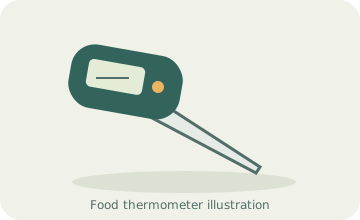
InstaProbe HT03 suits a common cooking pattern: open the lid, check a few pieces or positions, decide what needs more time and remove the thermometer. Its folding form and illuminated readout support that quick return to the task. It is a poor substitute for a monitor that stays in a roast. If you want an alert while you prepare the rest of dinner, start with a leave-in system instead.
A fine tip is particularly relevant when your challenge is reaching the centre of a relatively thin piece without driving a thick stem through it. The original guide specifies a taper at the end of the probe. That helps explain its intended handling, but it does not remove the need to choose a sensible insertion direction. For a thin cut, think about whether you can place the sensing end in the centre rather than measuring close to the pan or beyond the food.
Speed is useful only after placement is right
Typhur’s InstaProbe FAQ makes a half-second full-reading claim. This is a manufacturer specification, not a timing result from our own kitchen. More importantly, a rapidly changing number is not necessarily the coldest part of the food. Allow yourself time to check another position when a thick or irregular piece makes a single reading questionable.
Imagine a tray containing pieces of noticeably different sizes. A monitor in one large piece can follow that one piece, but does not establish the condition of every smaller piece around it. A handheld thermometer is useful precisely because you can make a series of separate checks. The tradeoff is your attention: there is no unattended record or automatic finish notification simply because the probe reads quickly.
A bright display, with a straightforward battery routine
The original quick-start guide describes the OLED, folding on/off operation and motion wake. Set your preferred temperature scale at the battery compartment before a busy cooking session. That is an easier time to use a screwdriver than when you are holding a hot tray. Keep spare AAA batteries where you can find them and check the tool before starting a meal that depends on it.
The illuminated display is helpful when the main difficulty is seeing the reading. It does not create phone connectivity, a second receiver or a timer alarm. Nor should the folding probe be confused with proof that the displayed characters rotate. Buy for the handling features actually documented, and consider your usual hand position and line of sight.
The high food range does not make the body oven-safe
The guide separates the probe’s measurement range from the electronic body’s much lower permitted ambient conditions. That makes the intended routine clear: measure by hand and take the instrument out. Do not close it inside the oven, leave it in cooking food or expose it to a microwave. A wide range on the specification sheet describes what the sensor can measure, not where the whole instrument can live.
Likewise, the water-protection label does not override the cleaning instructions. The original guide prohibits a dishwasher and immersion. Clean it after use using the maker’s permitted method, allow a hot probe to cool before handling it and avoid contaminating a cooked item with residue from an earlier raw-food check. The practical cleaning routine belongs in the buying decision, especially if you are choosing between a wipe-clean pen and a different instrument with explicitly permitted washing methods.
Choose this role, not a bundle of imagined features
HT03 is the original InstaProbe identified in Typhur’s declarations, separate from InstaProbe Core HT06. This review does not transfer features between those names. Choose it for deliberate handheld checks and a lit local display. Look elsewhere for continuous cooking supervision, remote temperature alerts or a dishwasher-cleaning requirement. Those are different needs, and a fast spot-checking tool does not satisfy them merely by being convenient to hold.
Key details at a glance
| Documented spot-check use | Yes |
|---|---|
| Documented leave-in monitoring | No |
| Included food probes | 1 |
| Fahrenheit display | Yes |
| Celsius display | Yes |
| Illuminated instrument readout | Yes |
| Dishwasher-safe food probe | No |
| Measuring without batteries or charging | No |
| Documented food range minimum | -58°F |
| Documented food range maximum | 572°F |
| Probe length | 109 mm |
| Probe-tip diameter | 1.5 mm |
| Manufacturer accuracy claim | Original guide: ±0.5°F at -4–248°F; ±1.8°F outside that band. Half-second full-reading response is the maker FAQ claim, not an independent test. |
| Power arrangement | Two AAA batteries; unfold to switch on, fold to switch off; motion wakes after sleep. |
| Care notes | Handheld only. Original guide prohibits oven, microwave, dishwasher and immersion; clean after each use with an appropriate food-safe wipe. |
Use the exact model’s instructions for operating limits, supplied equipment and version differences.
Sources for this assessment
Find a thermometer for your cooking routine.
Compare the documented measuring setups, included equipment and features that matter to you.