
Your needs, this model
Does it fit your priorities?
Do its two probes measure two foods simultaneously?
No. The original manual says the external connection makes the instrument read only that probe, even with the folding stem open. Each routine has one active food measurement.
Explore this need in the finder →Can the same instrument spot-check and use a cabledprobe?
Yes. The folding stem serves an attended check; the external probe provides the separate cabled routine. The display stays outside cooking heat.
Explore this need in the finder →Does user calibration apply to the connectedexternalprobe?
The instructions say to remove the external probe before calibration. Do not treat the built-in probe's ice-point procedure as verified external-probe adjustment.
Explore this need in the finder →Two probes, but one active reading
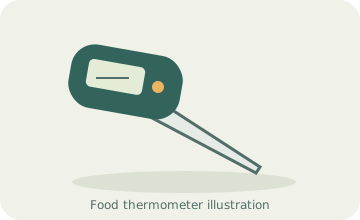
The Umedo DT-121 combines a folding food probe with a detachable external probe. Its most important limitation is explicit in the original instructions: once the external probe is plugged in, the instrument reads only that probe, even if the folding stem is also open.
This is a two-routine tool rather than a two-food monitor. You can use the built-in stem for an attended check or switch to the external cabled probe. If your actual need is to follow two different foods simultaneously, the number of physical probes in the package is not enough; choose a genuine multi-channel instrument.
Use the folding probe for a local check
Opening the folding stem turns the instrument on, while closing it turns it off when the external probe is disconnected. The local display provides hold and backlight controls. A short press can freeze the settled reading so that you can withdraw the stem and see the number more conveniently.
The rotating stem is not proof of a rotating readout. These are different conveniences. If readable character orientation from either side is essential, compare an exact model whose instructions establish display rotation, such as the documented DOQAUS CP8.
The external probe changes the setup
With the external probe connected, the display indicates the external reading. The food sensor can be placed where required while the handheld instrument remains outside cooking heat. Keep the connection protected and route the cable without damage rather than treating the whole assembly as one heat-proof object.
The original instructions exclude using the stainless probe sensor above 572°F. They list a higher limit for the wire alone, but that does not raise the sensor's restriction. The display must also stay away from direct heat. A high cable rating cannot make every part of the arrangement safe at that same temperature.
The high alarm is a chosen-temperature function
Pressing ALARMSET enters a target-setting mode. The instructions let the user adjust the high temperature and confirm it; exceeding that setting produces a beep and a flashing alarm indication. This is a food-temperature alert, distinct from a simple kitchen timer or a stable-reading sound.
Set the target to suit the food and verify the measurement location. The thermometer responds to the temperature at its active probe, not to every part of a large roast or several pieces on a grill. A clean-looking display cannot compensate for the tip measuring the wrong location.
Calibration has a probe-specific boundary
The original booklet describes an ice-point adjustment, but specifically tells the user to remove the external probe first. That instruction matters. It establishes a procedure for the built-in measuring path, not proof that the same adjustment verifies or corrects the external probe.
Keep the probe in the prescribed ice-water arrangement during the procedure and follow the instructions for entering and completing calibration. An error can mean the required condition has not been reached; repeatedly pressing buttons in arbitrary cold water is not a useful accuracy check.
Care, power and the right routine
The DT-121 uses one CR2032 cell. Keep the plug and socket dry, hand-clean the metal tips and wipe the instrument rather than immersing it. The original cautions also exclude rain and microwave use. The probe and wire can remain hot after cooking, so handle them with appropriate protection.
Choose this exact documented edition when a local spot check plus a separate single-probe cabled routine is useful. Choose a multi-channel monitor when two foods must be tracked together, or an explicitly dishwasher-safe model when that cleaning method is essential. The value of the DT-121 is switching jobs with one display; it is not doing all of those jobs simultaneously.
Key details at a glance
| Documented spot-check use | Yes |
|---|---|
| Documented leave-in monitoring | Yes |
| Included food probes | 2 |
| Fahrenheit display | Yes |
| Celsius display | Yes |
| Illuminated instrument readout | Yes |
| User calibration adjustment | Yes |
| Measuring without batteries or charging | No |
| Documented food range minimum | -58°F |
| Documented food range maximum | 572°F |
| Manufacturer accuracy claim | Makerstates±2°Fonlyfrom−4°Fto302°F; this is not whole-range independenttesting. |
| Power arrangement | One 3 V CR2032 cell. Connecting the external probe overrides the built-in probe. |
| Care notes | Hand-clean the metal tips and keep the plug and jack dry. Do not immerse or use in rain; protect the unit from heat. The wire-only 716°F rating does not raise the probe's 572°F limit. |
Use the exact model’s instructions for operating limits, supplied equipment and version differences.
Sources for this assessment
Find a thermometer for your cooking routine.
Compare the documented measuring setups, included equipment and features that matter to you.