
Your needs, this model
Does it fit your priorities?
I want to check several chicken pieces with one small thermometer. Does this fit?
Yes. This is a one-at-a-time spot-check tool. Give each insertion time to settle and place the sensing tip inside the food rather than against the pan.
Explore this need in the finder →Can I leave it in a roast and wait for a beep?
No. The instructions explicitly prohibit leaving the DT392 in a hot oven. Choose a cabled leave-in thermometer with a temperature alarm for that routine.
Explore this need in the finder →Can I wash the whole thermometer in the dishwasher?
No. The stem is hand washed and dried; the head and junction must not be immersed. The sheath does not turn it into a dishwasher-safe instrument.
Explore this need in the finder →A pocket thermometer for checking the food in front of you
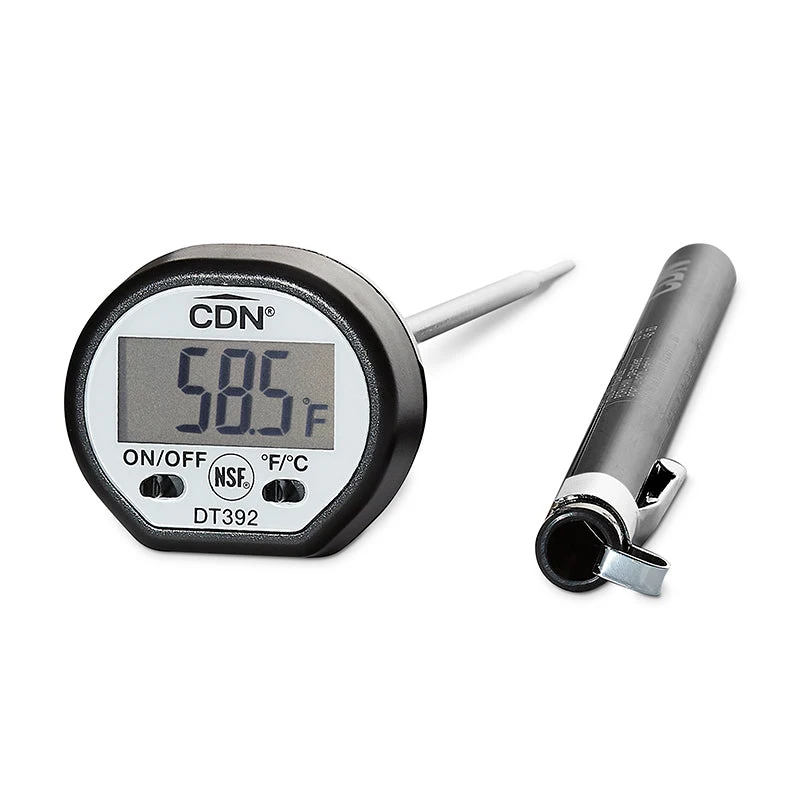
The CDN DT392 makes sense when your routine is to lift a lid, check a portion, then put the thermometer away. Its fixed stem and small digital head keep the job straightforward: insert, wait for the reading, remove and clean. There is no folding hinge to arrange and no receiver or phone to carry. Choose it for a simple measurement routine rather than for an elaborate cooking dashboard.
The deciding limitation is time and attention. CDN's instructions describe a six-to-eight-second response, so this is a tool to hold in position patiently, not one to wave quickly through several pieces of food. If you repeatedly check a busy grill, a faster pen may suit your pace better. If you want to watch a roast throughout cooking, the CDN DTP482 is the more relevant kind of tool.
The tip needs to be inside the food
The fixed stem measures at its lower quarter-inch. The instructions call for at least half an inch of insertion, which matters more than simply touching the surface with the metal. Think about where that tip ends up: in the part you want to measure, clear of the tray, rather than pushed through to a hot pan underneath. A stable number from the wrong location still answers the wrong question.
A thin piece can require a different approach from a deep roast. Before buying, consider whether you can place the sensing section inside the food you usually cook. The included sheath protects the pointed stem during storage and can extend the handle during use. It does not change how far the sensor has to enter the food, and it is not protection for leaving the thermometer inside an oven.
Simple controls, with a deliberate reading routine
A switch turns the DT392 on, and a separate selection changes between Fahrenheit and Celsius. The display shuts off after inactivity. These are useful conveniences if you move between recipes that use different units, but they do not remove the need to check the displayed unit before making a decision. Avoid mentally comparing a Celsius reading with a Fahrenheit target.
The maker gives a measurement range of −50°F to 392°F. That range concerns what the sensor can read, not an invitation to expose the plastic head to the same heat. The manual explicitly says not to leave the instrument in a hot oven or microwave. In practice, bring it to the food for a check and remove it afterward. A countertop cabled monitor solves a different problem by keeping its display outside while a suitable probe remains in place.
Cleaning and battery access are part of ownership
The DT392 uses an LR44 button battery. Its replacement procedure involves opening the head with a screwdriver, so this is not a battery-free alternative to a dial. Keep the battery compartment secure and store the instrument and spare cells where children cannot reach them. If avoiding cells altogether is your priority, compare a passive dial thermometer that supports the measuring routine you need.
Cleaning requires similar care. Hand wash and dry the stem, wipe the head and keep liquid out of the junction. CDN does not permit dishwasher cleaning or immersion. Make a clean place for the thermometer between checks so that a washed stem does not go straight back onto a surface touched by raw food. The protective cover is storage equipment, not a substitute for cleaning.
When to choose something else
Choose the DT392 if you want a compact, self-contained reading and can accept a short pause at every measurement. Choose a leave-in alarm thermometer if you want to be told when a target is reached. Choose a faster spot-check instrument if the number of checks makes waiting burdensome. Those decisions change the way you cook more than a broad temperature-range headline does.
For food-specific targets and rest times, use the current Food Safety.gov guidance. A thermometer supplies a reading; correct placement and the appropriate target determine what you can do with it.
Key details at a glance
| Documented spot-check use | Yes |
|---|---|
| Documented leave-in monitoring | No |
| Included food probes | 1 |
| Fahrenheit display | Yes |
| Celsius display | Yes |
| Dishwasher-safe food probe | No |
| Measuring without batteries or charging | No |
| Documented food range minimum | -50°F |
| Documented food range maximum | 392°F |
| Probe length | 119 mm |
| Probe-tip diameter | 1.7 mm |
| Manufacturer accuracy claim | Maker specifies ±1.7°F (1°C); instructions describe a6–8-second response. This is not a measured result. |
| Power arrangement | One LR44 alkaline button battery. |
| Care notes | Hand wash the stem, dry, and keep the head and its junction out of liquid; no dishwasher or oven storage during cooking. |
Use the exact model’s instructions for operating limits, supplied equipment and version differences.
Sources for this assessment
Find a thermometer for your cooking routine.
Compare the documented measuring setups, included equipment and features that matter to you.