
Your needs, this model
Does it fit your priorities?
Can I use one tool to check a pan surface and the inside of a steak?
Yes, with different sensors: use infrared for a surface reading and the inserted metal probe for the food interior. The surface result cannot replace an internal reading.
Explore this need in the finder →Does its infrared sensor count as a separate live smoker-chamber probe?
No. The documented handheld surface check is not an included simultaneous leave-in chamber sensor.
Explore this need in the finder →Can I rinse it after a messy cooking session?
The maker says no: the IHT-1M is not waterproof and calls for a damp cloth rather than rinsing or submersion. Choose another model if washability drives your choice.
Explore this need in the finder →Two temperature questions, answered by different sensors
The INKBIRD IHT-1M is useful when your cooking involves both a surface question and an internal-food question. You might want to check a pan before adding food, then use the folding metal probe to check the food itself. Combining those jobs in one handle can reduce the number of tools beside the stove. The important part is choosing the correct sensor for each question.
An infrared result describes the surface it sees. It cannot tell you whether the centre of a thick portion has reached an appropriate temperature. That distinction makes the IHT-1M a more specialised choice than a basic pen: its extra function is useful only if you have a real surface-reading task. If you mainly need internal checks and easier washing, compare the IHT-1P rather than choosing this one simply because it has more modes.
Think of it as a checking tool
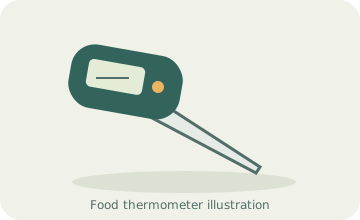
The food probe folds out from the handheld body. The practical routine is to bring the tool to the food, insert the sensor, wait for the result and remove it. The local screen means the reading does not depend on a phone. The maker also describes a selectable temperature target and a beep, alongside count-up and countdown functions.
Those extra controls do not turn the handheld body into an oven-safe monitor. A temperature alarm can be useful during an attended check or suitable measurement task, but an alarm by itself says nothing about where the display can withstand heat. If your main requirement is to leave a probe in a roast throughout cooking, choose a thermometer whose instructions explicitly support that arrangement.
Infrared adds a separate step
With two sensing methods, consistency matters more than the length of a feature list. Decide first whether you are measuring the food interior or an exposed surface. For an internal check, use the probe. For a surface check, consider what the infrared reader is actually pointing at and avoid treating that result as the temperature of everything behind or beneath it.
A smoker-chamber reading is another distinct job. Pointing an infrared tool at a grate or wall is not the same as leaving a sensor in the cooking air beside the food. The IHT-1M therefore should not be chosen as though it supplies two simultaneous monitoring channels. One handheld probe plus one surface mode is a different arrangement from a food probe and a dedicated chamber probe.
Convenience features require a little preparation
The instrument uses a rechargeable battery and an included USB-C lead. Charging belongs in your preparation routine, particularly if the thermometer spends long periods in a drawer. The magnetic side can make it easier to store within reach, provided the surface is cool and suitably positioned. Putting a useful tool near the stove is sensible; putting its body against cooking heat is a different matter.
The maker provides a user-calibration function. Treat it as a way to correct an established offset rather than an invitation to adjust every surprising number. A reading can be unexpected because the sensor is in the wrong position or has not settled. Check the method and reference before changing the instrument's adjustment.
Cleaning is the major everyday compromise
INKBIRD explicitly says the IHT-1M is not waterproof and advises damp-cloth cleaning rather than rinsing or submersion. That changes its suitability in a messy preparation area. You need to clean the food-contact probe carefully while protecting the rest of the instrument, rather than expecting to wash the whole tool under a tap or put it through a dishwasher.
Choose it if the combination of surface checks, inserted food checks and a local timer is genuinely useful to you. Choose a simpler washable pen if you rarely use infrared. Choose a leave-in monitoring system if you need a continuous food or chamber reading while you work elsewhere. The best fit comes from the temperature question you need answered, not from assuming three functions can replace every other thermometer.
Key details at a glance
| Documented spot-check use | Yes |
|---|---|
| Included food probes | 1 |
| Fahrenheit display | Yes |
| Celsius display | Yes |
| Dishwasher-safe food probe | No |
| User calibration adjustment | Yes |
| Measuring without batteries or charging | No |
| Documented food range minimum | -58°F |
| Documented food range maximum | 572°F |
| Power arrangement | Built-in250mAh rechargeable battery,USB-C cable included. |
| Care notes | Maker says the IHT-1M is not waterproof;damp-cloth cleaning instead of rinsing or immersion. |
Use the exact model’s instructions for operating limits, supplied equipment and version differences.
Sources for this assessment
Find a thermometer for your cooking routine.
Compare the documented measuring setups, included equipment and features that matter to you.