
Your needs, this model
Does it fit your priorities?
I want a backlit thermometer for quick checks without a phone. Is this the right type?
Yes. Its folding food probe and lit handheld display support local spot checks. Hold the tip in place until the reading settles.
Explore this need in the finder →Can I adjust a small reading offset myself?
Yes. The original manual gives a user calibration procedure with an adjustment range of±5°F/±3°C. Use a sound reference procedure rather than guessing an offset.
Explore this need in the finder →Does a rotating probe mean the number flips upright for either hand?
Not necessarily. The documented 180-degree rotation is the metal probe hinge; an automatically rotating readout is not established for this model.
Explore this need in the finder →A handheld check with a useful hold button
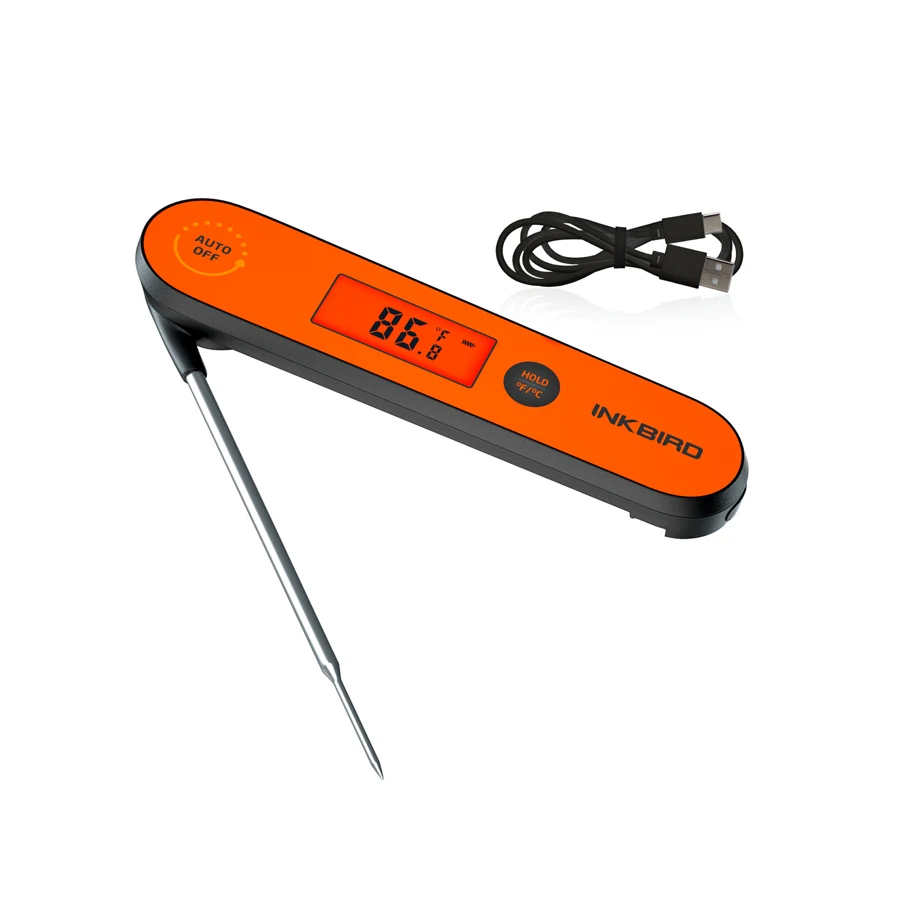
The INKBIRD IHT-1P suits a cook who wants a reading at the food, then wants to move the display somewhere easier to see. Its folding probe, illuminated screen and reading-hold function work together for that job. You can insert the tip, let the number settle, hold the result and withdraw the thermometer before reading it comfortably. It is especially worth considering when a pan or serving position makes the screen awkward to face.
Buy it for that checking routine. A rechargeable battery does not make it a wireless leave-in monitor, and a folding probe does not make the display heat resistant. If you want to close the oven and receive a target-temperature alert later, a CDN DTP482-style cabled monitor answers that need more directly.
What the folding design changes
Opening the probe turns the IHT-1P on; folding it back turns the unit off. This makes the act of taking a reading a fairly self-contained operation. Before closing it, clean and dry the food-contact metal so that storage does not trap residue against the body. A magnetic back can keep it accessible between checks, but choose a cool storage surface away from the cooking heat.
INKBIRD describes the probe as rotating through 180 degrees. That means you can adjust the metal stem's position relative to the handle. It is not evidence that the displayed characters automatically turn upright when you swap hands. If that feature matters to you, look for a model that explicitly specifies a rotating readout rather than relying on a photograph of an open hinge.
Wait for a settled reading
The maker's own materials give different response-time descriptions, so there is little value in treating one advertised number as a guaranteed wait for every food. Position the tip in the part you need to measure and wait for a stable result. A number that appears immediately can still be moving toward the food's actual temperature. The hold button is most useful after that pause, not as a shortcut around it.
Fahrenheit and Celsius can be selected on the instrument. The published measuring range is broad, but that is a sensor-reading range rather than a promise that the whole handheld unit can remain in a very hot oven. Keep the distinction between touching food with the probe and heating the display body clear when choosing your equipment.
Calibration is an adjustment, not an automatic guarantee
The original instructions provide a user adjustment for a small offset. This is a meaningful difference from instruments whose maker only says they are factory calibrated. It gives you a way to correct a known discrepancy, provided the reference and procedure are sound. Changing the number until it looks plausible is not the same as establishing that the measurement is accurate.
If you use an ice or boiling-water reference, account for the reference conditions rather than assuming every kitchen setup reproduces an ideal laboratory value. If a reading is unstable, give the probe more time and check its condition before adjusting it. Calibration cannot repair physical damage or make an unsuitable placement representative of the whole food.
Charging and washing need different kinds of care
The built-in battery replaces disposable-cell changes with a charging task. Keep the charge routine in mind if you use a thermometer only occasionally: finding a USB lead during meal preparation is less convenient than charging it before you start. Follow the specified supply requirements rather than assuming every fast-charging arrangement is appropriate.
The maker allows rinsing under running water while separately cautioning against immersing the handheld part. That is useful splash protection, not permission for a dishwasher cycle. Wash the food-contact probe after use, protect the charging area and let the instrument dry before storing it. Choose the IHT-1P for a lit local check and reading hold; choose a documented dishwasher-safe probe if machine cleaning is a firm requirement.
Key details at a glance
| Documented spot-check use | Yes |
|---|---|
| Included food probes | 1 |
| Fahrenheit display | Yes |
| Celsius display | Yes |
| Illuminated instrument readout | Yes |
| User calibration adjustment | Yes |
| Measuring without batteries or charging | No |
| Documented food range minimum | -58°F |
| Documented food range maximum | 572°F |
| Manufacturer accuracy claim | Maker specifies ±2°F/±1°C. Product highlight says3–5seconds whileFAQ says2–3seconds; no exact numeric response promoted. |
| Power arrangement | Built-in250mAh lithium battery;USB charge using specified5V supply. |
| Care notes | Maker permits running-water rinsing but says not to immerse the handheld part;IPX5 does not establish dishwasher permission. |
Use the exact model’s instructions for operating limits, supplied equipment and version differences.
Sources for this assessment
Find a thermometer for your cooking routine.
Compare the documented measuring setups, included equipment and features that matter to you.