
Your needs, this model
Does it fit your priorities?
Can I move the display away from a difficult viewing angle?
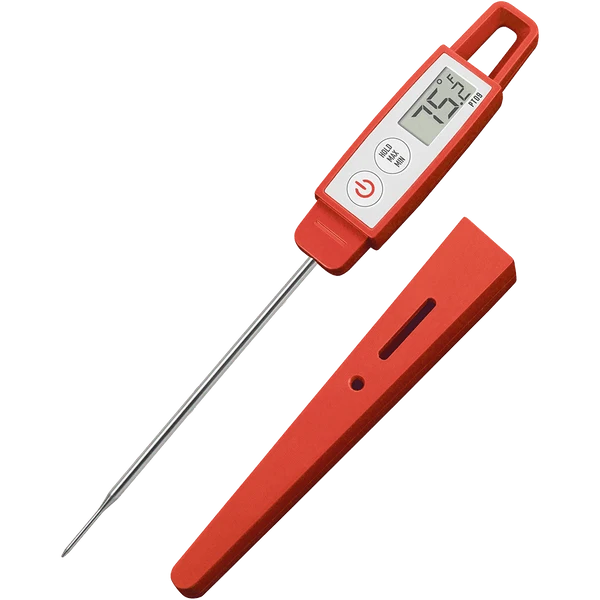
The PT09 has a temperature-hold function. Capture the settled reading before withdrawing the probe, then read that held value in a more convenient position. It is not a live remote reading.
Explore this need in the finder →Does splash resistance mean I can put it in the dishwasher?
No dishwasher permission is established by the PT09 specification. IP65 is described as splash resistance; choose a model with explicit dishwasher instructions when that is a requirement.
Explore this need in the finder →Can this cover a 400°F measurement with the same stated accuracy?
The measuring range reaches 482°F, but the published ±0.9°F accuracy band stops at 302°F. Range coverage and accuracy at a particular temperature are different questions.
Explore this need in the finder →A traditional stem with useful reading controls
The Lavatools PT09 suits a cook who wants to reach for a conventional fixed-stem thermometer, take a local reading and put it away. Its useful differences are the hold function, minimum/maximum memory and switchable units. These are practical controls for reading and recording food temperatures, rather than a phone system or a roast alarm.
The fixed stem also changes storage. There is no folding joint to close between uses, so consider where a pointed tool will go on your counter or in your kit. Choose this format because you prefer its handling, rather than assuming it shares every feature of Lavatools' folding models. The PT09 is its own product.
Hold is helpful when the food is awkward to read
Some checks are easy to position but awkward to see: a pot is low on the stove, or the food is on a tray at an uncomfortable angle. Temperature hold lets you capture a settled value and bring the display into view. That is different from continuing to measure the food while the probe is elsewhere. A held number describes the captured reading, not the food's changing temperature after withdrawal.
The minimum/maximum function can also be useful when comparing readings during a session. Keep track of what you actually measured, however. Memory is not a guarantee that the stem stayed in the right part of the food, and a highest reading is not automatically the lowest or most relevant reading within a large piece.
Read the range and accuracy band separately
The manufacturer publishes a measuring range from −40°F to 482°F. Its stated ±0.9°F accuracy applies only within −4°F to 302°F. That distinction matters if you want to use the same tool near the hot end of its scale: a number can be within the measuring range without carrying the accuracy claim printed for a narrower band.
Lavatools describes a typical response of five to six seconds. Treat that as a maker specification, not a measured promise that every cold or hot food will settle in exactly that time. Position the tip where the reading is needed and allow it to settle. Moving through several locations too quickly can make a nominally quick thermometer less useful than a deliberate check.
A small tip does not make placement automatic
The specification lists a tapered 1.6 mm tip. That describes the tip geometry; it does not establish a minimum suitable food thickness or authorize leaving the housing in cooking heat. A fixed metal stem should not be mistaken for a leave-in roast probe. This review treats the PT09 as the documented handheld spot-check tool.
Fahrenheit and Celsius can be configured on the instrument. Decide which unit you intend to follow before taking the reading, particularly when a recipe and a food-safety reference use different scales. A unit setting changes how a number is displayed; it does not choose the correct food-specific endpoint for you.
Power and cleaning need their own decision
The PT09 uses one LR44 button cell. That is convenient if you prefer a replaceable cell to a charging dock, but it remains a powered thermometer. The advertised operating-hours figure is not an independent battery-life test and will not tell you exactly when your own battery needs replacing.
The maker calls the tool IP65 splash resistant. This is not a dishwasher instruction. Do not turn splash protection into permission for immersion, a hot wash cycle or oven use. Likewise, the advertised antimicrobial coating does not remove the need to clean a probe between foods.
When it fits
Choose the PT09 when a local digital reading, a familiar fixed stem and hold/memory functions match your routine. Compare the CDN DT392 for another fixed-probe approach, paying attention to each model's range and care instructions. If your actual need is to leave a probe in a roast and hear a chosen-temperature alert, select a documented monitoring thermometer instead. The PT09's value is a focused spot-check workflow, not a collection of unverified extra modes.
Key details at a glance
| Documented spot-check use | Yes |
|---|---|
| Included food probes | 1 |
| Fahrenheit display | Yes |
| Celsius display | Yes |
| Measuring without batteries or charging | No |
| Documented food range minimum | -40°F |
| Documented food range maximum | 482°F |
| Probe-tip diameter | 1.6 mm |
| Manufacturer accuracy claim | Maker specifies ±0.9°F only from −4°F through 302°F; typical response is a 5–6-second interval, not a single guaranteed time. |
| Power arrangement | One LR44 button cell; published 4000+ hours is a manufacturer claim, not an endurance test. |
| Care notes | Manufacturer calls it IP65 splash resistant; this does not establish immersion or dishwasher permission. |
Use the exact model’s instructions for operating limits, supplied equipment and version differences.
Sources for this assessment
Find a thermometer for your cooking routine.
Compare the documented measuring setups, included equipment and features that matter to you.