
Your needs, this model
Does it fit your priorities?
Can I take a local reading without a battery or phone?
Yes. This Chef's Precision model uses a passive bi-metallic coil and a local dial. It does not need a phone or electronic receiver for the reading.
Explore this need in the finder →How much of the probe has to go into the food?
OXO says to insert until the shaded section is covered. That marked area matters; do not assume a shallow tip-only insertion is sufficient.
Explore this need in the finder →Can I select it for a chosen-temperature sound alert?
No. This passive instant-read dial is for looking at the number during an attended check, rather than an electronic selected-target sound.
Explore this need in the finder →A passive dial for an attended food check
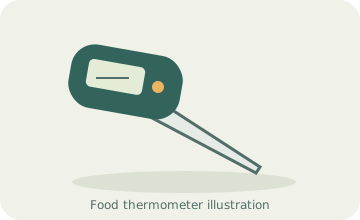
The OXO Chef's Precision 11133300 is a bi-metallic-coil thermometer with a local dial. It fits a cook who wants a food-temperature check without a battery, charging lead or phone connection. Bring the probe to the food, let the indication respond and read the face while you are there.
That simple routine is its appeal. There is no separate numerical receiver to carry or electronic target to program. If your real requirement is a sound when a roast reaches a chosen temperature, start with a monitoring thermometer instead. A familiar metal stem does not make every thermometer suitable for the same job.
The shaded sensing area is the key detail
OXO specifically says to insert the probe until its shaded area is covered. The important measurement point is therefore not just an arbitrarily shallow touch with the tip. The marked section needs to be placed in the food as instructed before the dial can provide a useful reading.
Consider that requirement when choosing a thermometer for the foods you cook most often. A piece must allow appropriate placement of the sensing section; a tool that works conveniently in a larger piece may be awkward in a very thin item. This review does not invent a minimum food thickness from the appearance of the stem, but it makes the placement requirement part of the decision.
A quick check is still a deliberate check
The maker describes a rapid-responding coil, but does not provide an independently measured response test here. Keep the probe in position long enough to obtain the reading you need instead of moving it through the food while assuming the pointer has already settled.
The dial reports the temperature where the sensing section is placed. It cannot establish that every part of a large item has the same internal temperature. Position and any additional checks should follow current guidance appropriate to the particular food, rather than relying on one convenient spot simply because it is easiest to reach.
Two printed scales can reduce unit switching
The documented face supports Fahrenheit and Celsius. With an analog scale, you read the appropriate markings rather than changing a digital setting. Decide which scale you are following before comparing the reading with a recipe or a food-safety reference.
Make sure the face is readable from the position where you normally work. A passive dial has different viewing needs from a backlit digital screen or a display that can freeze a value. If you need to move the instrument away from the food before seeing the number, compare a digital model with a documented hold function.
The cover helps with storage and reference
OXO supplies a probe cover with temperature guidance printed on it. It keeps the tool's reference information close to the instrument and provides a place for the pointed stem when stored. Clean and dry the probe as required by the instructions supplied with the actual unit before putting it away.
Printed doneness references are convenient, but current food-specific guidance still matters, including any required rest time. A cooking preference and a minimum safe internal temperature are not always the same question. Use the cover as a convenience rather than a reason to ignore the context of the food you are checking.
Choose it for this routine
The 11133300 makes sense when a battery-free, attended dial reading and an adequately inserted marked section fit your cooking. The read maker reference does not establish leave-in oven permission or dishwasher cleaning, so those functions are not added to this model's recommendation profile.
For an instructed leave-in dial, compare the Comark MT200K, checking its different measuring scale and cleaning directions. For a held local digital reading, compare the Lavatools PT09. The useful distinction is the way you take and view the measurement, rather than choosing by brand or metal construction alone.
Key details at a glance
| Documented spot-check use | Yes |
|---|---|
| Included food probes | 1 |
| Fahrenheit display | Yes |
| Celsius display | Yes |
| Measuring without batteries or charging | Yes |
| Power arrangement | Passive bi-metallic coil and local dial; the documented measurement needs no powered external readout. |
Use the exact model’s instructions for operating limits, supplied equipment and version differences.
Sources for this assessment
Find a thermometer for your cooking routine.
Compare the documented measuring setups, included equipment and features that matter to you.