
Your needs, this model
Does it fit your priorities?
Can I leave a thermometer in a roast without keeping batteries charged?
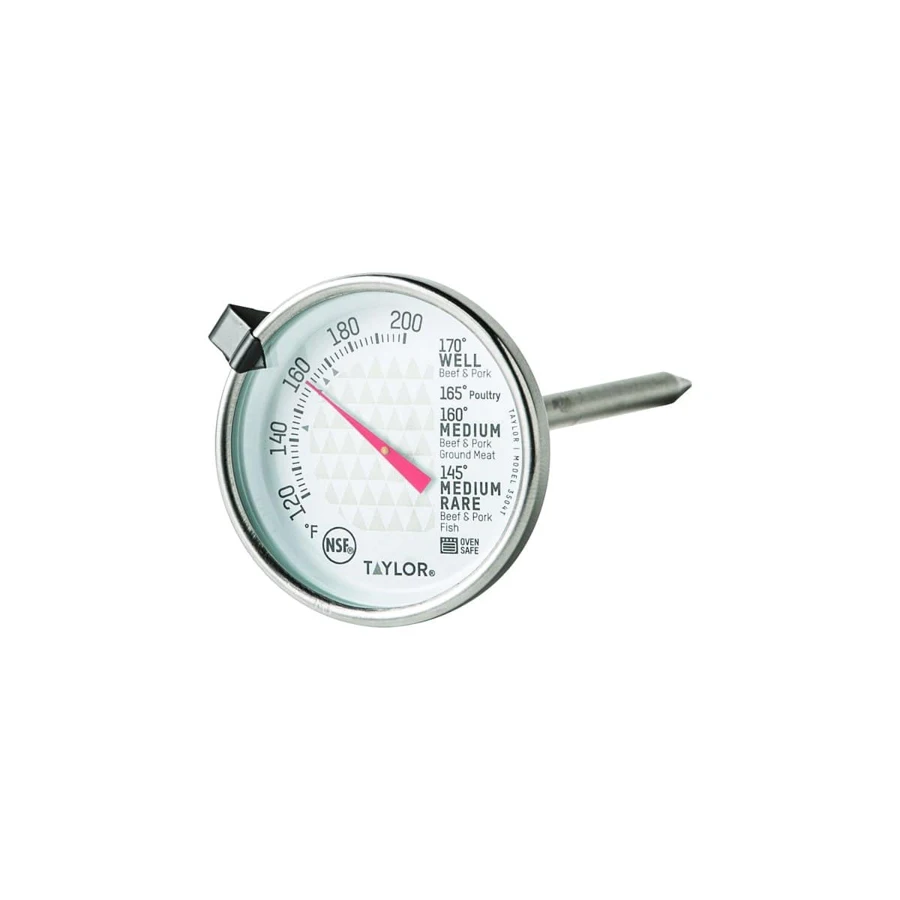
Yes. The 3504 uses a passive dial and is designed to remain in food during cooking. You must look at it to judge progress.
Explore this need in the finder →Will it beep at the marker I set?
No. The adjustable marker helps you compare the pointer with your target; it is not an electronic temperature alarm.
Explore this need in the finder →Is this useful for checking a few thin burgers quickly?
It is designed for leave-in monitoring with substantial insertion, not rapid one-at-a-time checks. A documented instant-read pen is the more suitable comparison.
Explore this need in the finder →A visible roast reading without batteries
The Taylor 3504 suits a simple oven routine: insert a dial thermometer into a substantial piece of meat, face it where you can see it and watch the pointer move during cooking. It needs neither a charging lead nor a receiver. If you dislike discovering that a seldom-used electronic thermometer has a flat battery, that passive design is a real reason to consider it.
Choose it only if you are willing to look at the reading yourself. The adjustable target marker is a visual reference. It does not sound an alarm when the pointer reaches it, and it does not send a message to a phone. A cook who wants to work elsewhere and be called back needs a different kind of monitor, such as the Taylor 1470N.
It belongs in a roast, not in a rapid checking routine
The 3504 is designed to remain in food during cooking. Taylor's insert describes positioning it in the thickest part, clear of bone, fat and gristle. That calls for more thought than simply putting the tip somewhere inside the outer edge. The location you follow should be relevant to the food's interior, not a hot tray or an air pocket.
The stem also needs room. A deep roast and a thin burger present different placement problems, so do not assume a leave-in dial is a convenient universal replacement for a small pen. If you mainly check individual thin pieces just before serving, a documented instant-read thermometer is a more natural fit. The 3504 solves the problem of following one position over time.
The marker helps you see progress
Set the movable reference to the target you intend to use, then compare the needle with that point as cooking proceeds. This can make a dial easier to interpret at a glance: you do not have to remember where your chosen number sits each time. It remains your responsibility to inspect the reading and take action.
A practical setup leaves the dial visible through the oven door where possible. Arrange the food and thermometer before the pan becomes hot, and think about whether racks or another dish will block your view. If seeing the face requires repeatedly pulling out a heavy roasting pan, an outside digital display may be more useful than the simplicity of the mechanical dial.
Use the range printed for this model
Taylor's current 3504 reference gives a 120°F–200°F measuring range. That makes it a meat-cooking instrument rather than a broad-range tool for checking cold storage, making candy or measuring very hot oil. A thermometer that cannot display the temperature you need is not made suitable by a convenient target marker.
The food-reading range is also different from the surrounding heat allowed by a particular cooking method. Follow the exact supplied instructions and do not infer permission for direct flame, broiling or a rotating spit merely because the device has no cable. Cable-free in this case means a self-contained dial, not a wireless transmitter or a proven rotisserie system.
Low-maintenance does not mean no care
After cooking, the metal and dial can be hot. Remove them with suitable hand protection and allow them to cool before cleaning. Taylor specifies handwashing, with no immersion and no dishwasher. Keeping food residue off the stem and face makes the next insertion and reading easier; the absence of a battery does not eliminate the need for cleaning and careful storage.
Choose the 3504 when a battery-free local dial matches how you cook and you can monitor it visually. Choose a digital alarm when an audible target matters, or a pen for quick checks in several places. For the actual food target and any required rest time, consult current Food Safety.gov guidance rather than relying only on the labels around an older dial.
Key details at a glance
| Documented spot-check use | No |
|---|---|
| Documented leave-in monitoring | Yes |
| Included food probes | 1 |
| Fahrenheit display | Yes |
| Illuminated instrument readout | No |
| Rotating displayed characters | No |
| Dishwasher-safe food probe | No |
| Measuring without batteries or charging | Yes |
| Documented food range minimum | 120°F |
| Documented food range maximum | 200°F |
| Power arrangement | Passive mechanical dial;no electrical display,receiver orbattery is part of measurement. |
| Care notes | Handwashonly;no immersion or dishwasher. |
Use the exact model’s instructions for operating limits, supplied equipment and version differences.
Sources for this assessment
Find a thermometer for your cooking routine.
Compare the documented measuring setups, included equipment and features that matter to you.