
Your needs, this model
Does it fit your priorities?
Can I follow a deep food position without charging a battery?
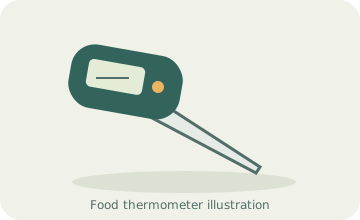
Yes. The documented MT-39 configuration uses an 8-inch stem and passive dial. Insert beyond the sensing groove as instructed and position the face where it can be seen.
Explore this need in the finder →Does this exact MT-39 have the adjustment nut shown on the MT-39R?
No. The maker separates the non-recalibrating MT-39 from the R model with an external adjustment feature. The suffix matters.
Explore this need in the finder →Will its dial alert me when my selected target is reached?
No. The documented arrangement gives a visual mechanical reading, not a temperature alarm. Choose an electronic monitor if a sound is essential.
Explore this need in the finder →A long stem for a specific measuring position
The Tel-Tru MT-39 is worth considering when the length of the probe is part of the problem you need to solve. This review concerns the documented 8-inch stem and 0–220°Ffood-dial configuration. It gives a passive mechanical reading without a receiver, phone or battery. For a deeper food position, that is a different proposition from a short pocket pen.
The same length can be a disadvantage when your usual food is small or thin. You need room to position the sensing section appropriately and support the dial without the instrument getting in the way. Choose the stem for the food and vessel you actually use, rather than assuming a longer probe is automatically more capable.
Insert beyond the sensing groove
Tel-Tru's original catalog instructs users to immerse the stem beyond its lower groove for an accurate reading. That is a sensor-placement requirement, not permission to submerge the head. A long metal stem touching the surface does not necessarily have its full sensing section inside the food you intend to assess.
Before cooking, consider where the face will sit when the sensing section is correctly positioned. A useful insertion angle should also leave the dial visible and stable. If the only comfortable position leaves the sensing section poorly placed, change the measuring arrangement instead of accepting a convenient but unrepresentative reading.
The exact suffix changes the adjustment feature
The catalog distinguishes MT-39 from MT-39R. The R model has the external recalibration arrangement; the non-R MT-39 does not acquire that feature because the two names appear next to each other. If adjusting the indication yourself is a firm requirement, check the exact model rather than buying from a family photograph or an abbreviated title.
This matters when replacing an existing instrument as well as when choosing a new one. A matching dial size does not establish the same stem, range or adjustment hardware. The MT-39 is part of a configurable family, so the physical configuration and printed scale should be checked alongside the model name.
A passive dial provides information, not a reminder
The mechanical reading avoids charging and battery replacement. It also asks the cook to look at the dial. There is no selected-target beep in the documented arrangement, and there is no remote receiver carrying the number elsewhere. If an alert is the reason you want a thermometer, a local electronic monitor is a more direct solution.
A passive self-contained stem has no outside cable, but that should not be confused with a radio-equipped food probe or an explicitly supported rotating-spit arrangement. The catalog describes oven-related construction for MT models, while exact surrounding-heat and cleaning limits still need the instructions for the actual configured instrument. The 0–220°Fscale is a food-reading range, not a heat rating for every part.
Where this configuration fits
The long-stem MT-39 fits a cook who has a suitable deeper food position and wants a local mechanical reading. It is less convenient for a rapid series of checks in small portions or for situations where the dial will be hidden. An instrument that reaches the desired point but cannot be read practically is not the most useful choice.
For a simpler roast-focused dial, compare the Taylor 3504 and its own insertion and range limits. For a target alarm outside the oven, compare a cabled digital monitor. For repeated spot checks, compare a smaller pen. Select the complete measuring routine first, then choose the stem and display that let you perform it correctly.
Key details at a glance
| Documented leave-in monitoring | Yes |
|---|---|
| Included food probes | 1 |
| Fahrenheit display | Yes |
| User calibration adjustment | No |
| Measuring without batteries or charging | Yes |
| Documented food range minimum | 0°F |
| Documented food range maximum | 220°F |
| Probe length | 203.2 mm |
| Manufacturer accuracy claim | Original catalog specifies±1% of full span for this bimetal family;not independently tested and not±1°F. |
| Power arrangement | Passive bimetal dial with no required powered external equipment. |
Use the exact model’s instructions for operating limits, supplied equipment and version differences.
Sources for this assessment
Find a thermometer for your cooking routine.
Compare the documented measuring setups, included equipment and features that matter to you.