
Your needs, this model
Does it fit your priorities?
Can I make local spot checks in Fahrenheit or Celsius with illuminated, rotating numbers and user calibration?
Yes. The manual supports both units, automatic illumination and configurable rotation. The separate ONE trim procedure documents user adjustment after a proper reference check.
Explore this need in the finder →Can the included food probe go in a dishwasher?
No. The exact ONE manual explicitly says it is not dishwasher safe. The IP67 rating does not supersede that instruction.
Explore this need in the finder →Can I leave this thermometer in an oven and get an alert at a temperature I choose?
No supported arrangement does that. The manual prohibits oven placement, the body limit is 122°F, and no selected-temperature monitoring alarm is established for the ONE.
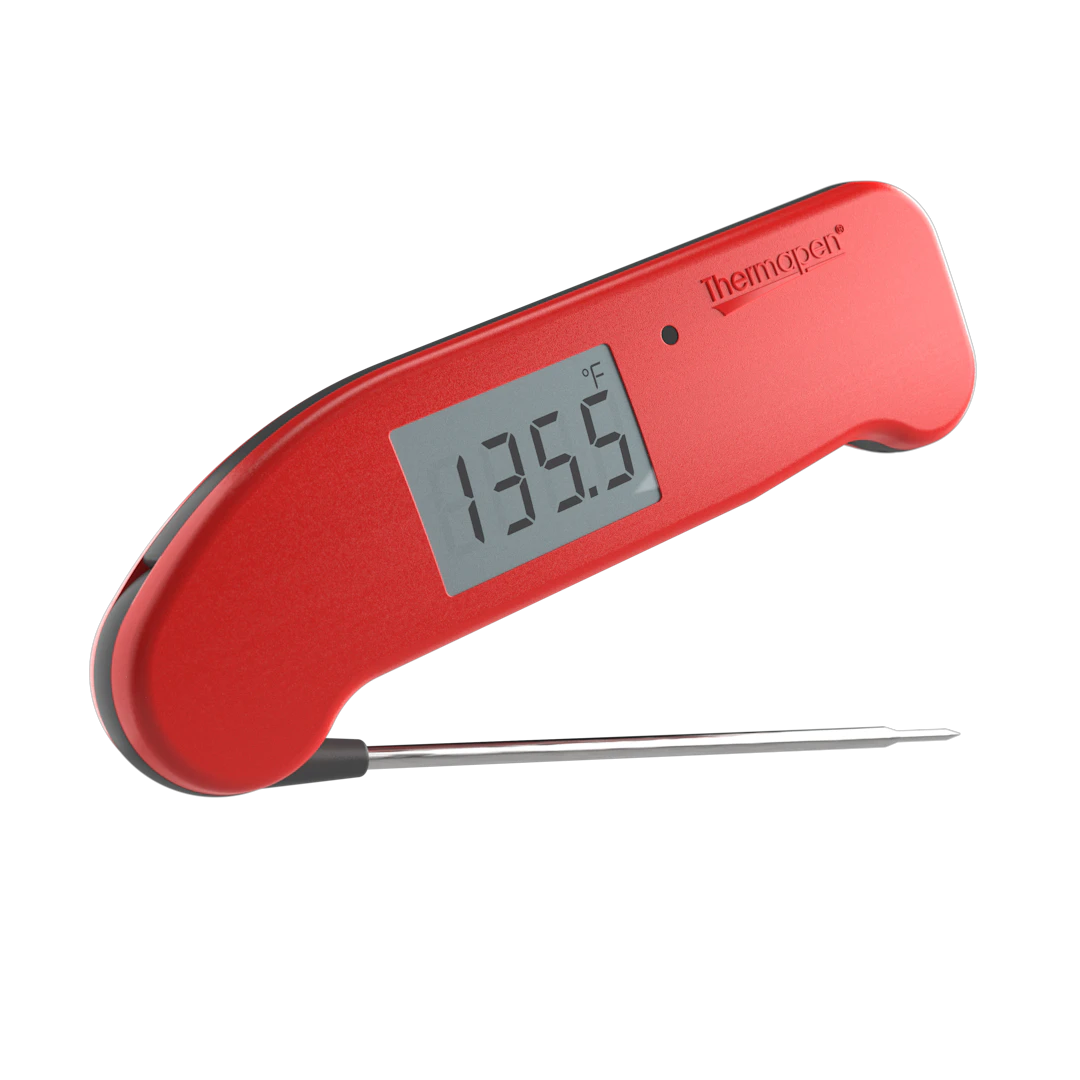
Explore this need in the finder →ThermoWorks Thermapen ONE suits the cook who wants a quick answer while standing over the food and wants control over how that answer appears. Its folding needle, automatic display rotation and light-sensitive backlight help with awkward approaches to a roast or a crowded pan. The maker's one-second response claim is useful context, but the more consequential distinction is the routine: insert the tip, find the place you need to measure, read it and remove it. This is a handheld checking instrument, with no supported leave-in monitoring plan in this assessment.
Quick readings still require deliberate placement
The specification gives a food measurement range of −58 to 572°F. Accuracy is stated as ±0.5°F from −4 to 248°F and ±1.8°F outside that band, up to the listed extremes. The tighter figure therefore does not describe the entire range. A calibration certificate accompanies the instrument, but that is evidence about calibration rather than a promise that every hurried insertion will represent the whole dish.
The sensor sits at the reduced tip of the 4.3-inch probe. The manual calls for at least 1/8 inch of tip immersion. That short sensing area is helpful when looking for a particular internal location, yet the needle still needs to reach that location without touching a pan or bone. Check more than one position when the food's shape or uneven heating warrants it. The operating instructions describe reaching within 1°F of a properly made ice bath in one second and warn that other foods can take longer. We have not measured its response ourselves.
Readable controls with a little setup work
Unfolding the needle switches the ONE on; folding it away switches it off. The hinge stops at 180 degrees, so forcing it farther is not a way to improve access. The readout can rotate through 360 degrees, helping when a left-handed approach or a low pan changes the angle. The backlight responds to available light and stays on for at least ten seconds. Its brightness can decrease when the battery is low, which is a useful diagnostic before assuming the display has failed.
The controls inside the battery compartment set Fahrenheit or Celsius, display resolution, rotation behavior and sleep timing. You can choose 360-degree rotation, a restricted orientation or a locked display rather than accepting one automatic behavior forever. Adjustable sleep and motion wake make sense for repeated checks during prep. They do not create a food alarm, a remote receiver or a phone connection.
Calibration is an actual procedure here
The ONE has a separate manufacturer calibration-trim instruction, not just a certificate or an unexplained settings menu. It directs the user to make a proper ice bath, check the reading and adjust only if needed. The available trim is ±3.6°F, followed by another check. Someone who wants a serviceable checking tool can reasonably value this documented route. Someone who does not have confidence in making a reference bath should not treat the adjustment as a routine improvement or use it to compensate for poor food placement.
A single AAA battery comes preinstalled according to the exact manual. ThermoWorks states 2,000 hours of battery life; that is its specification, not our endurance result. Replacement involves the compartment screw and careful reassembly. Keep an appropriate screwdriver and a spare cell available if this is the tool you rely on for frequent checks.
Water resistance has clear boundaries
The body is rated IP67, but the instructions still prescribe wiping the probe, body and hinge area with appropriate cleaning materials. They expressly say the ONE is not dishwasher safe. They also warn against rotating the probe while it is underwater and against solvents that can damage the housing or screen. Grease and oil around the hinge deserve attention; the probe is not a skewer for lifting or flipping heavy food.
Keep the instrument out of the oven and off hot surfaces. Its −4 to 122°F body operating range is separate from its much higher food measurement range. A momentary check of hot food does not authorize leaving the handle in the cooking environment. A dishwasher requirement or an oven-monitoring requirement should therefore remove this model from the corresponding shortlist.
Choosing ONE alongside the newer options
The current US page explicitly describes a ONE closeout. We treat it as a current manufacturer reference, without asserting stock, future color availability or a particular selling price. Ordinary color choices do not turn this model into a different wireless instrument. The newer Thermapen NANO has accessible external settings and a different display design; the exact NANO user-calibration procedure was not recovered, so ONE's documented trim should not be transferred to it.
Choose the ONE when local, readable spot checks and documented adjustment are the actual priorities. Compare the ChefAlarm when food must remain connected to an oven-safe probe and trigger a selected-temperature alert. To keep the shortlist focused on the ONE's supported strengths, use local spot checks with both units, illumination, rotation and user calibration.
Key details at a glance
| Documented spot-check use | Yes |
|---|---|
| Included food probes | 1 |
| Fahrenheit display | Yes |
| Celsius display | Yes |
| Illuminated instrument readout | Yes |
| Rotating displayed characters | Yes |
| Dishwasher-safe food probe | No |
| User calibration adjustment | Yes |
| Measuring without batteries or charging | No |
| Documented food range minimum | -58°F |
| Documented food range maximum | 572°F |
| Probe length | 109.22 mm |
| Probe-tip diameter | 1.52 mm |
| Manufacturer accuracy claim | The maker specifies ±0.5°F from −4 to 248°F and ±1.8°F from −58 to −4°F and 248 to 572°F. Its one-second response is a stated claim; the manual describes within 1°F of an ice bath in one second and warns that other food readings may take longer. No independent response test is claimed. |
| Power arrangement | One AAA 1.5 V battery comes preinstalled according to the exact manual. The maker specifies 2,000 hours of battery life. Sleep can be set from 10 to 180 seconds or disabled; the manual documents motion wake. These are manufacturer specifications, not our endurance results. |
| Care notes | The exact manual prescribes wiping the probe, body and hub and explicitly says the ONE is not dishwasher safe. It prohibits use in an oven or on hot surfaces, warns against rotating the probe underwater, and warns that solvents can damage the housing. IP67 does not override these instructions. |
Use the exact model’s instructions for operating limits, supplied equipment and version differences.
Sources for this assessment
Find a thermometer for your cooking routine.
Compare the documented measuring setups, included equipment and features that matter to you.