
Your needs, this model
Does it fit your priorities?
Can I make local food spot checks in Fahrenheit or Celsius with illuminated, automatically rotating numbers?
Yes. The exact 4.5-inch manual documents selectable units, a ten-second button backlight and an automatically rotating local readout.
Explore this need in the finder →Can I adjust this model's calibration myself?
That remains unconfirmed. The included certificate describes calibration evidence, but an exact owner trim procedure was not recovered for this TX-3120 configuration.
Explore this need in the finder →Can I leave it inside an oven and get an alert at a temperature I choose?
No supported arrangement does that. The exact manual explicitly prohibits leaving it inside ovens and does not establish a selected-temperature food alarm.
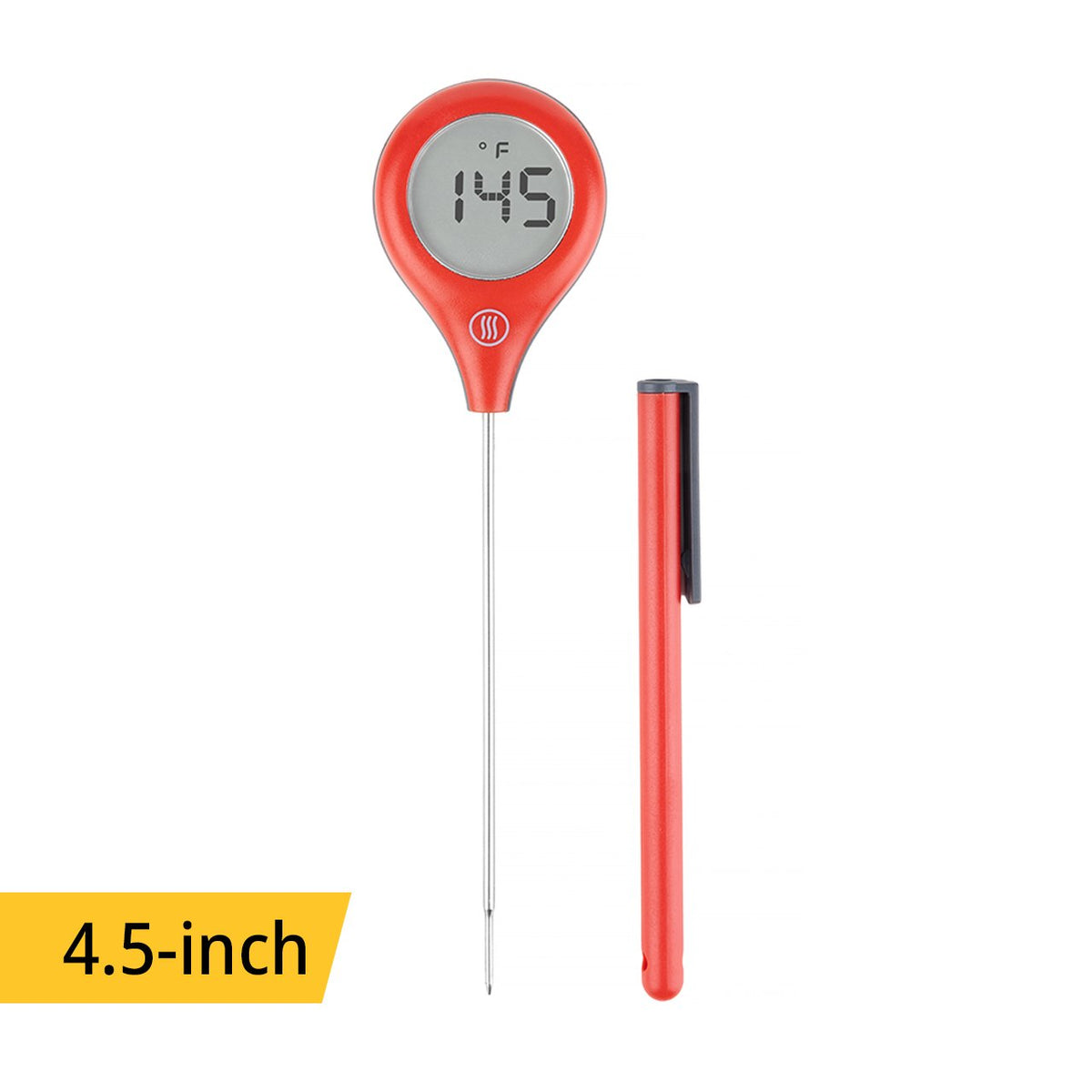
Explore this need in the finder →The 4.5-inch ThermoPop 2 is the shorter of two materially different stem configurations. It suits ordinary handheld checks when a compact straight probe and large, readable numbers matter more than folding storage or unattended cooking. The control scheme is intentionally sparse: one button handles power, illumination and unit changes. This review concerns the TX-3120 configuration; the longer TX-3130 has its own dimensions and response claim.
A compact stem with a reduced tip
The exact shorter-model manual lists a 4.5-inch needle, approximately 114 mm long. Its shaft narrows from 2.5 mm to a 1.5 mm tip. That gives a practical distinction from the 8-inch model's thicker 2 mm tip. For a small portion or a short approach from the side of food, the shorter instrument can be easier to position without managing a long exposed stem behind your hand.
The stem is straight rather than folding into the display head. The maker's information sheet describes a matching sheath for storage. Let the needle cool and clean it before putting it away, and think about where an exposed straight probe will sit between checks. Buying the shorter version is a choice about reach and handling, not a promise that it can reach every large roast from any direction.
Response and accuracy are qualified specifications
ThermoWorks states a two-to-three-second response for this 4.5-inch version. The 8-inch version is specified at three to four seconds, so the headline speed should not be transferred between them. These are maker claims; we have not timed either configuration. Wait for a stable reading and make sure the sensor is in the intended internal location rather than touching the cooking vessel.
The measurement range is −58 to 572°F. The exact manual states ±1°F accuracy from 14 to 208°F, ±4°F from 392 to 572°F and ±3°F otherwise. That last category matters for temperatures between 208 and 392°F: the best advertised accuracy does not apply everywhere the instrument can display a number. The included calibration certificate establishes calibration evidence, while user adjustment remains unconfirmed because no exact trim procedure was recovered.
One button, several timed actions
Press the button to turn the thermometer on. Once it is running, another press activates the backlight, which the specifications list for ten seconds; a further press turns the light off. The readout rotates automatically through a full circle in ninety-degree steps. This combination is helpful when the hand approaching a pan is not the hand you would normally use to hold a display upright.
Fahrenheit and Celsius selection requires holding the button for three seconds during startup. Holding it for five seconds switches the instrument off. Automatic shutdown occurs after ten minutes and can be disabled or restored through a six-press sequence. It is worth learning those actions before a busy cooking session so a unit change does not become an experiment while food needs attention.
The large food range does not protect the handle
The body operating range is 32 to 122°F. The care section separately warns against exposing the entire thermometer above 190°F and explicitly says not to leave it inside an oven. Neither statement authorizes continuous oven use below the food probe's 572°F reading limit. The supported arrangement here is a handheld check with the display and your hand kept away from excessive cooking heat.
The manual tells the owner to clean the probe immediately after each measurement. The IP67 rating helps describe resistance to water ingress, but it is not a dishwasher instruction. Exact dishwasher permission was not established, so someone who insists on machine-cleanable food probes should use a model with explicit approval. No continuous food alarm, remote view or chamber-monitoring plan is supported for this package.
Battery care and practical ownership
A CR2032 coin cell supplies power and the maker specifies 4,000 hours of life. That is a stated specification, not an endurance result from our use. Replacement uses a screwdriver on the rear cover; follow polarity markings and avoid overtightening. A small spare cell can be convenient for frequent use, but it should be stored appropriately rather than left loose with kitchen tools.
The single-button layout and simple local screen are attractive when several people need straightforward readings. They provide fewer ways to automate the cooking process. Choose this model when the user will be there to check, interpret and act on the number.
Choose the length before the color
The 8-inch ThermoPop 2 provides more insertion reach but has a thicker tip and a different response specification. The Thermapen ONE offers folding storage and documented user trim. For this shorter ThermoPop, start with local spot checks with selectable units, a backlight and rotating numbers, then decide whether 4.5 inches provides the reach your food and vessels require.
Key details at a glance
| Documented spot-check use | Yes |
|---|---|
| Included food probes | 1 |
| Fahrenheit display | Yes |
| Celsius display | Yes |
| Illuminated instrument readout | Yes |
| Rotating displayed characters | Yes |
| Measuring without batteries or charging | No |
| Documented food range minimum | -58°F |
| Documented food range maximum | 572°F |
| Probe length | 114 mm |
| Probe-tip diameter | 1.5 mm |
| Manufacturer accuracy claim | The exact 4.5-inch manual states ±1°F from 14 to 208°F, ±4°F from 392 to 572°F and ±3°F otherwise. Its response claim is two to three seconds; this is not an independently timed result or the long model's three-to-four-second claim. |
| Power arrangement | One CR2032 3 V coin cell; the maker specifies 4,000 hours of battery life. The rear cover uses a screwdriver. A five-second hold turns the instrument off; ten-minute automatic shutoff can be disabled or restored with six presses. Battery life is not our measured result. |
| Care notes | The exact manual says to clean the probe immediately after each measurement and not to leave the instrument inside an oven. Body operation is 32–122°F; the separate whole-tool 190°F exposure warning is not a continuous operating permission. Exact dishwasher approval was not established despite IP67. |
Use the exact model’s instructions for operating limits, supplied equipment and version differences.
Sources for this assessment
Find a thermometer for your cooking routine.
Compare the documented measuring setups, included equipment and features that matter to you.