
Your needs, this model
Does it fit your priorities?
Can this exact model confirm a 165°F poultry target?
No. Its documented upper reading is 160°F. Choose a thermometer whose exact range covers the required target.
Explore this need in the finder →Does the C in SLTH160C mean it reads Celsius?
The original catalog uses C for card packaging and lists this row in Fahrenheit. A Celsius scale is not established for the exact model.
Explore this need in the finder →Can I keep it in the oven or clean it in the dishwasher?
No. The maker explicitly excludes both uses for this pocket model. It is an attended spot-check tool.
Explore this need in the finder →Check the upper limit before choosing this pocket dial
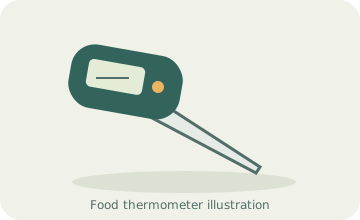
The Thunder Group SLTH160C is a small analog food thermometer for an attended local check. Its pocket case and clip make the arrangement easy to understand: bring the stem to the food, take the reading and put it away after cleaning. It is not an outside display with a probe left in the oven.
The deciding limitation is the exact range. The documented upper reading is 160°F. That does not cover a 165°F poultry target, so this model is not a suitable universal finishing thermometer for a kitchen that needs to confirm that temperature. A familiar dial shape should not distract from whether the printed scale actually reaches the number you need.
The suffix describes packaging
Thunder Group's original catalog lists SLTH160C as the card-packaged version and prints its range in Fahrenheit. The C suffix should not be interpreted as proof of a Celsius scale. If you commonly follow Celsius recipes, select a thermometer whose exact documentation establishes that unit instead of inferring it from a model code.
Other nearby products in the catalog also have different ranges. A similar pocket case or matching brand does not make their scales interchangeable. Check the actual model and face when comparing a replacement, especially if the reason for replacing your current thermometer is a missing temperature range.
Use it as a handheld check
The manufacturer's product reference explicitly excludes oven use. The stem may be metal, but that does not establish that the head can remain in cooking heat. Take the reading with the tool in hand and remove it afterward. A compact pocket form is convenient for checking; it is not an instruction to leave the thermometer embedded in a roast.
Placement still matters. You need the sensing part inside the food you intend to measure, rather than reading the tray or a nearby surface. Give the indication time to settle and choose a position relevant to the food. A clear pointer can still give an unhelpful answer if the stem is in the wrong place.
Understand what a passive local reading changes
A self-contained analog dial avoids a separate electronic display or phone connection. That can suit a cook who wants a basic number at the food without setting up another device. It also means the documented routine depends on looking at the instrument, not carrying a live readout into another room.
If a target alert is important, choose a product whose exact instructions establish that function. If continuous oven monitoring is important, choose a documented leave-in arrangement. A pocket thermometer can be a useful tool without being either of those other products, provided its actual limitations fit your cooking.
Care and a more suitable alternative
The maker explicitly says the SLTH160C is not dishwasher safe and must not be used in a microwave. Protect the pointed stem in its case after cleaning and drying, and use the care instructions supplied with the actual unit. Do not transfer dishwasher permission from another stainless-steel utensil or another thermometer in the range.
For a broader-range local food check, compare the CDN DT392. For a roast reading that stays in the oven, compare a suitable leave-in dial or cabled monitor. For food-specific targets, including poultry and any required rest times, consult current Food Safety.gov guidance. Choose the SLTH160C only when the measurement you need is within the documented range and an attended pocket-dial routine is enough.
Key details at a glance
| Documented spot-check use | Yes |
|---|---|
| Documented leave-in monitoring | No |
| Included food probes | 1 |
| Fahrenheit display | Yes |
| Dishwasher-safe food probe | No |
| Measuring without batteries or charging | Yes |
| Documented food range maximum | 160°F |
| Power arrangement | Self-contained analog dial;no powered external readout in the documented arrangement. |
| Care notes | Manufacturer explicitly excludes dishwasher,microwave and oven use. |
Use the exact model’s instructions for operating limits, supplied equipment and version differences.
Sources for this assessment
Find a thermometer for your cooking routine.
Compare the documented measuring setups, included equipment and features that matter to you.