
Your needs, this model
Does it fit your priorities?
Can one probe follow food and its nearby cooking air together?
Yes. The single supplied probe has five internal sensors and one ambient sensor. It follows one food plus the air near the ceramic end, with the below-notch section properly inserted.
Explore this need in the finder →Does 752°F mean I can leave it in a 650°F cooker for an hour?
No. The exact version 1.2 manual limits exposure above 572°F to ten minutes. The sustained monitoring plan therefore does not satisfy 650°F surroundings, even though 752°F appears in the headline specifications.
Explore this need in the finder →Can I set a target and hear the alert without watching a phone?
Yes. Manual mode lets you set the target on the included base, and the Ready state alarms there. Phone and internet viewing are additional routes, not required to read the base.
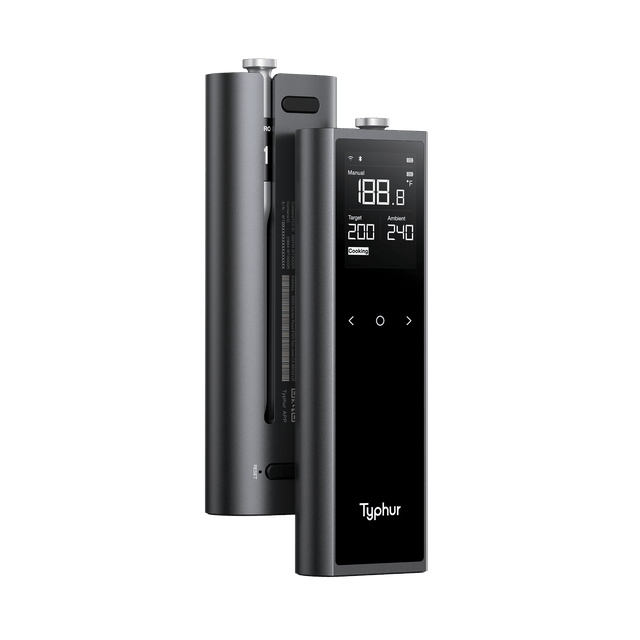
Explore this need in the finder →The Typhur Sync One Pro WT13 suits a cook who usually follows one substantial piece of food and wants a cable-free probe with a usable base display. It adds a longer-range Sub-1G radio link to Typhur's single-probe format. The important compromise is not just the one-food limit: its exact manual also places a time limit on very hot surroundings, so the advertised 752°F ceiling is not an unrestricted long-cook rating.
One food, with a separate view of its surroundings
The supplied probe has five internal sensors and one ambient sensor. Those internal sensors help the system find the lowest reading along the inserted portion; they do not provide five independent food channels. You can follow one roast and the air near its exposed handle. A second steak with a different finishing target still needs another actual food probe.
This arrangement is useful if your normal dinner revolves around one main item. It can be unnecessarily restrictive when you regularly cook several portions that finish at different times. Typhur's exact US product page lists one probe, the device base, a USB-C cable and the manual. Additional probes or a second kit should not be treated as included equipment.
Three radio names describe two different links
Sub-1G is the connection between the food probe and its base. The maker advertises up to 3,000 feet in open space and 700 feet in a closed-space test. Those are conditional manufacturer claims, not distances established in your kitchen. A metal cooking enclosure, walls and where you put the base all affect the useful connection.
Bluetooth and 2.4GHz Wi-Fi concern the phone and network side of the setup. The base can display the cooking information locally, while the supported app supplies phone viewing and remote access when the base has the required network connection. Internet viewing does not let you leave the base anywhere you like: it still needs to communicate with the probe in the cooker. Test both links before depending on a remote alert.
The manual changes the high-heat buying decision
The WT13 manual, version 1.2, distinguishes an internal range of 32–221°F from an ambient maximum of 752°F. More specifically, PDF page 5 prohibits cooking above 572°F ambient for more than ten minutes. That duration condition matters for a long hot roast, repeated searing or a grill that develops unexpected hot spots.
We therefore use 572°F for the sustained monitoring setup represented in the finder. The higher number remains a qualified short-exposure specification. It is not permission to exceed the internal sensor limit or expose the entire needle to cooking air. Insert beyond the safety notch, keep the internal sensing section inside suitable food and leave the ceramic end exposed as instructed. A thin piece that cannot accommodate that insertion is a poor candidate for this probe.
Choose a target, then understand which mode is working
Manual mode lets you set a target on the base and alerts when the measured food reaches it. Smart mode uses the target and warming rate to estimate an earlier removal point and a later ready state. The two modes answer different questions. An algorithm's prediction does not replace checking whether the tip is positioned correctly or choosing suitable guidance for the actual food.
The product page specifically names oven, grill, smoker and rotisserie uses. The cable-free construction is helpful on a rotating spit, but check the same heat, insertion and radio conditions before using it there. Keep the base off the hot appliance. Its screen and battery belong outside cooking heat even though the probe has a much higher exposure specification.
Charging and cleaning are part of each cook
The probe returns to the base to charge, and the base itself needs USB charging. The manual describes non-replaceable batteries, so this is not a battery-free instrument or a device you maintain simply by swapping AAA cells. Check both battery indicators before a long session and keep the charging contacts clean.
The exact manual permits washing the cooled probe by hand or in a dishwasher, while excluding the base from immersion and dishwashing. It also prohibits specified harsh cleaners and running a just-used hot probe under cold water. Follow those distinctions rather than applying the probe's IPX8 description to the whole kit.
Our purchase judgment
Shortlist the One Pro for one-food monitoring where radio obstacles and a local base matter. Consider the ChefAlarm for a straightforward cabled local alarm, or the InstaProbe Core for manual checks of many pieces in turn. The WT13's advantage is its complete single-probe monitoring arrangement; neither range claims nor six sensors increase its included food count.
Compare one-food cable-free monitors with a local temperature alert and chamber reading, then add your actual surrounding-heat requirement.
Key details at a glance
| Documented leave-in monitoring | Yes |
|---|---|
| Included food probes | 1 |
| Fahrenheit display | Yes |
| Celsius display | Yes |
| Dishwasher-safe food probe | Yes |
| Measuring without batteries or charging | No |
| Documented food range minimum | 32°F |
| Documented food range maximum | 221°F |
| Whole probe surrounding-heat maximum | 572°F |
| Manufacturer accuracy claim | The maker states internal accuracy of ±0.5°F. One food probe contains five internal sensors and one ambient sensor. No independent accuracy trial or numeric response time is claimed. |
| Power arrangement | One rechargeable probe, a charging base and a USB-C cable are included. The manual describes non-replaceable batteries and a 3.7 V, 1950 mAh base battery. Charge both units and keep the contacts clean. A mains adapter is not listed as included. |
| Care notes | Let the probe cool before hand washing or dishwasher cleaning. The base is not waterproof and must not be immersed or put in the dishwasher. Follow the manual's exclusions for alcohol, ammonia, benzene and abrasive cleaners; do not use the probe in a microwave or pressure cooker. |
Use the exact model’s instructions for operating limits, supplied equipment and version differences.
Sources for this assessment
Find a thermometer for your cooking routine.
Compare the documented measuring setups, included equipment and features that matter to you.