
Your needs, this model
Does it fit your priorities?
Can this cover a 450°F spot measurement?
The exact maker page gives a −40°F to 500°F range, covering 450°F on the measuring scale. This is not permission to put the handheld display in that heat.
Explore this need in the finder →How far does it need to go into the food?
The original 9841 card requires at least 1.5 inches of insertion in the thickest relevant part. That placement requirement should fit what you cook.
Explore this need in the finder →Does its one-second update mean a one-second finished reading?
No. The card describes the display updating every second until a stable reading is reached. Refresh interval and settling response are different.
Explore this need in the finder →A broad scale, with a clear insertion requirement
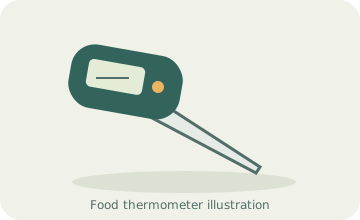
The Taylor 9841 is a pocket-style digital thermometer for an attended food check. Its manufacturer lists a measuring range from−40°F to 500°F, with Fahrenheit and Celsius operation. That broad scale can be useful if your measurements extend beyond the narrow band printed on a roast-only dial.
Before choosing it, consider the original insertion instruction: at least one and a half inches of the stem should be in the food. The ability to place the probe correctly matters as much as the number at the top of the advertised scale. A convenient-looking pen is not automatically the best choice for every thin or small item.
Measure the food, rather than the tray
The instruction card directs insertion into the thickest relevant part, away from fat, bone, gristle and the pan. That helps explain what this kind of instrument is doing: the stem must be in a suitable food location while the display remains available for you to read.
A high reading is not useful if the sensor is touching the pan or another unintended surface. Likewise, a single convenient position does not prove uniform temperature throughout a large item. Take the checks appropriate to the food instead of treating one visible number as a complete assessment.
A display update is not a settling-time promise
Taylor's original card says the display updates every second until a stable reading is reached. That is a refresh interval, not a guarantee that the thermometer has finished responding after one second. Let the reading stabilize in position before deciding what the measurement means.
This distinction matters when comparing thermometers. A screen can change quickly while the sensing element is still responding. This review does not turn the update interval into a laboratory response test, and it does not assign an invented speed score to the 9841.
Switch units before comparing numbers
The instrument has a Fahrenheit/Celsius control. Choose the unit you intend to use before checking a recipe or another reference. A value that is sensible in one scale can be misleading when compared with a target printed in the other.
The maker lists a 0.4-inch LCD and a plastic storage case with a pocket clip. Those are practical portability details rather than remote-monitoring features. Think about whether you can see the local screen comfortably in your working position, especially if lighting is poor or you usually approach food from an awkward angle.
The handheld display stays out of the oven
The original card explicitly says not to place the thermometer in the oven. If more cooking is needed after a check, remove the thermometer from the food and return the food to the oven. The 500°F measuring endpoint does not change that instruction.
This is therefore a bring-to-the-food, read-and-remove routine. If you want a probe to remain inserted and sound at a chosen temperature, compare a genuine leave-in system. A metal stem alone is not evidence that the attached display can tolerate a cooking appliance.
Battery access and careful comparisons
The card describes a replaceable battery in the housing. Follow the directions for the actual unit when opening it and fitting a replacement. This review does not borrow a cell type from another Taylor thermometer simply because the products look similar.
The 9841 fits a cook who wants a local digital check, switchable units and the documented broad scale, and whose foods allow the required insertion. Compare the Taylor 9847N if a held reading is a priority, or the Lavatools PT09 for another fixed-stem approach. Match the actual instructions and controls to your routine instead of treating nearby model numbers as interchangeable.
Key details at a glance
| Documented spot-check use | Yes |
|---|---|
| Documented leave-in monitoring | No |
| Included food probes | 1 |
| Fahrenheit display | Yes |
| Celsius display | Yes |
| Measuring without batteries or charging | No |
| Documented food range minimum | -40°F |
| Documented food range maximum | 500°F |
| Power arrangement | Replaceable battery in the housing; the exact cell type is not established by the read card and is not borrowed from the 9847N. |
| Care notes | The handheld instrument must not stay in the oven. Follow the actual unit's care instructions; dishwasher permission is not established. |
Use the exact model’s instructions for operating limits, supplied equipment and version differences.
Sources for this assessment

Find a thermometer for your cooking routine.
Compare the documented measuring setups, included equipment and features that matter to you.