
Your needs, this model
Does it fit your priorities?
Can I make local spot checks in Fahrenheit or Celsius and adjust the thermometer's calibration myself?
Yes. The battery-compartment switches select units, and the exact linked Classic trim procedure documents adjustment after a proper ice-bath check.
Explore this need in the finder →Can I require illuminated, automatically rotating numbers for local spot checks?
Those features remain unconfirmed for this exact Classic configuration. They are not borrowed from ONE or NANO, so an essential illumination-and-rotation requirement is not satisfied by the established evidence.
Explore this need in the finder →Can I leave Classic in an oven and receive an alert at a temperature I choose?
No supported plan does that. Its exact manual prohibits oven placement, the body limit is 122°F and no selected-target cooking alarm is established for this package.
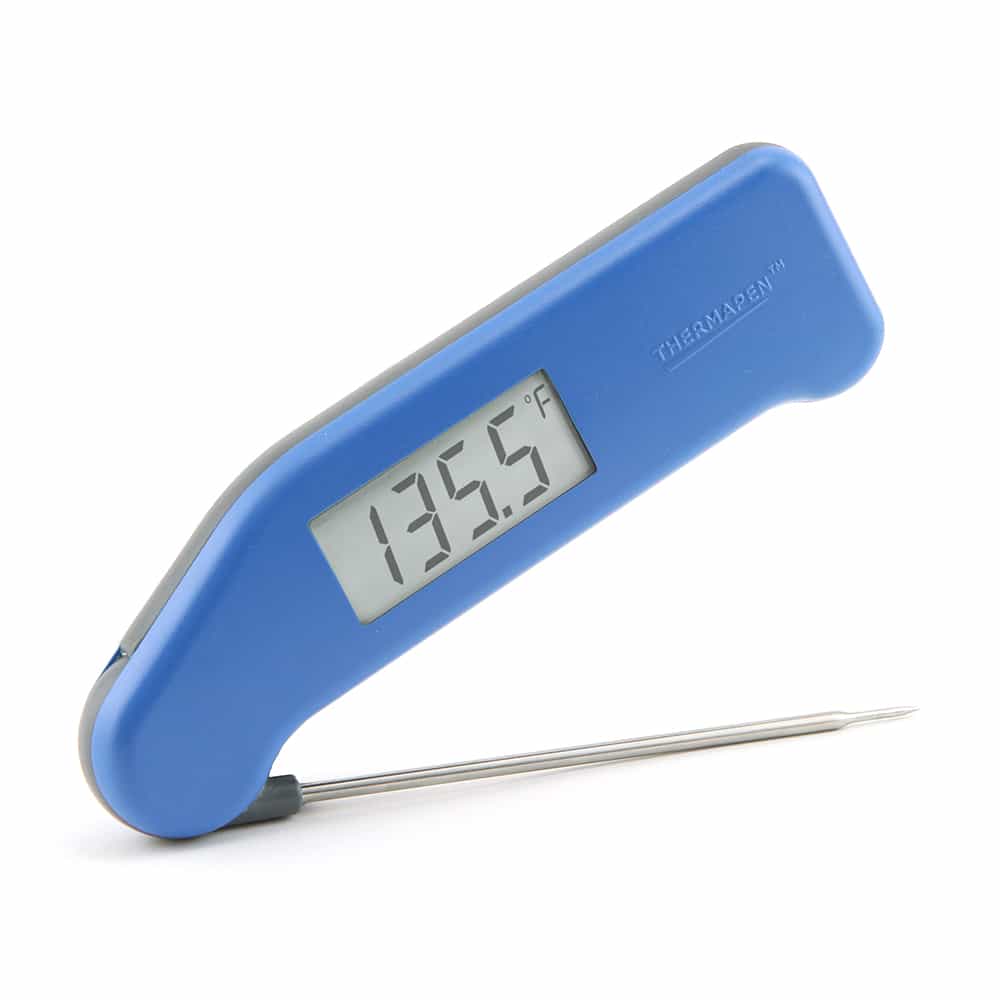
Explore this need in the finder →Classic Super-Fast Thermapen is a folding, local-read thermometer for someone who wants a direct food check and a documented way to verify and adjust the instrument. It has a broad measurement range, a long integral needle and a deliberately simple operating sequence. Its appeal depends on accepting the Classic's actual controls and cleaning rules. Features advertised for Thermapen ONE or NANO should not be assumed merely because the family name and folding silhouette look familiar.
A long needle for checking one place at a time
The product specification lists a 4.5-inch probe and a −58 to 572°F measurement range. Those numbers describe reach and measurement capability, not how deep the sensor must be buried or how much heat the handle can tolerate. The manual locates the sensor at the reduced tip and calls for at least 1/8 inch of immersion. This lets you check an intended internal location rather than averaging the temperature along the full stem.
That is useful for a thick roast, but it also makes placement your responsibility. Approach the area you want to check, allow the reading to settle and consider additional positions in irregular food. Contact with a hot pan, an air pocket or another unrepresentative location can defeat the purpose of a quick instrument. The folding probe should not be used to lift heavy food or forced past the hinge's 180-degree limit.
Keep the maker's speed and accuracy claims in context
ThermoWorks currently advertises readings in one to two seconds. Its linked Classic operating instructions describe getting within 1°F of a properly made ice bath in three seconds and explain that other foods can take longer. Those are different stated conditions, so this assessment does not turn them into a single independently verified response time. Speed is a convenience; a representative food reading remains the goal.
The specified accuracy is ±0.7°F from −58 to 392°F and ±1.8°F from 392 to 572°F. The tenth-degree display resolution is not a tenth-degree accuracy guarantee. The supplied NIST-traceable certificate and the documented checking procedure are more useful to a careful owner than reading extra significance into the final digit.
Controls live behind the battery cover
The exact operating instructions say to unfold the probe to turn the Classic on and fold it away to turn it off. It automatically turns off after ten minutes unless that function is disabled. Switches inside the battery compartment select Fahrenheit or Celsius, resolution, automatic shutoff and calibration-trim mode. This is practical for someone who sets preferences once and then repeatedly opens, checks and closes the instrument. It is less convenient when different users frequently change units.
The current web description also uses pick-up motion language, but the exact Classic manual describes the folding action and ten-minute shutoff. We rely on that documented sequence rather than promising ONE-style motion wake. Likewise, this evidence set does not establish a backlight or automatically rotating numbers for Classic. If either feature is essential, select a model with explicit support instead of assuming this one qualifies.
User adjustment, with careful reference checks
The maker links a dedicated calibration procedure for this splash-proof Classic. It describes making a proper ice bath, checking first, enabling trim through the switch bank and adjusting by up to ±3.6°F. The procedure ends with another check. That is a real owner adjustment route, distinct from the certificate that accompanies a new unit.
It is not a reason to change calibration before every meal. A poorly prepared bath or an incorrectly positioned tip can lead to a needless correction. Follow the maker's method and seek support when the instrument behaves inconsistently. Two CR2032 cells come preinstalled according to the manual, with a stated 1,500-hour battery life. Battery life is a maker specification; we have not run an endurance test. The coin-operated cover needs careful closure after replacement or changing settings.
Splash resistance does not authorize immersion
The page lists IP65 and the exact instructions explicitly say not to immerse the thermometer. Wipe the probe, body and hub using the prescribed cleaning approach; keep oil, flour and residue from collecting around the hinge. The manual warns that alcohol solvents can damage the case or screen. Exact dishwasher permission was not established, so an essential dishwasher requirement remains unconfirmed.
The manual also prohibits putting Classic in an oven or leaving it on hot surfaces. The body operates from −4 to 122°F. Its 572°F food measurement ceiling therefore supports brief checks with the handle protected from the cooking heat, not an oven-monitoring arrangement. No selected-temperature food alarm, remote view or ambient chamber-monitoring plan is established for this package.
When Classic is the sensible choice
Consider Classic when a folding needle, local numbers, selectable units and documented user trim meet the entire job. The Thermapen ONE supplies explicit illumination and automatic rotation, along with different batteries and water-care instructions. The ChefAlarm addresses continuous cooking and an alarm instead of requiring repeated manual checks. Neither comparison justifies borrowing their features for Classic.
Our local spot-check preset with Fahrenheit, Celsius and user adjustment captures Classic's documented strengths. It is a good starting point when the straightforward checking routine matters more than an unverified convenience feature.
Key details at a glance
| Documented spot-check use | Yes |
|---|---|
| Included food probes | 1 |
| Fahrenheit display | Yes |
| Celsius display | Yes |
| User calibration adjustment | Yes |
| Measuring without batteries or charging | No |
| Documented food range minimum | -58°F |
| Documented food range maximum | 572°F |
| Probe length | 114.3 mm |
| Manufacturer accuracy claim | The maker specifies ±0.7°F from −58 to 392°F and ±1.8°F from 392 to 572°F. The current product advertises one-to-two-second readings; the exact operating manual describes within 1°F of a properly made ice bath in three seconds and warns other foods may take longer. No universal response time or independent trial is asserted. |
| Power arrangement | Two CR2032 3 V cells come preinstalled according to the exact manual. The maker specifies 1,500 hours of battery life. Opening the folding probe turns the instrument on, closing it turns it off, and ten-minute automatic shutoff can be disabled through the switch bank. |
| Care notes | The exact Classic manual says not to immerse it, not to put it in an oven and not to leave it on hot surfaces. Wipe the probe, body and hub using the prescribed approach and protect the hinge from residue. Exact dishwasher permission was not established. The IP65 rating does not override the no-immersion instruction. |
Use the exact model’s instructions for operating limits, supplied equipment and version differences.
Sources for this assessment
Find a thermometer for your cooking routine.
Compare the documented measuring setups, included equipment and features that matter to you.