
Your needs, this model
Does it fit your priorities?
Can I make local internal-food spot checks in Fahrenheit or Celsius with automatically rotating numbers?
Yes. The instrument's actual folding penetration probe supports internal food checks, both units and a readout rotating in ninety-degree steps. The infrared surface function is separate.
Explore this need in the finder →Can the penetration probe measure a 600°F internal food target?
No. Its specified penetration range stops at 572°F. The infrared sensor's higher surface-reading ceiling cannot raise the internal food probe's limit.
Explore this need in the finder →Can I monitor food and cooking-chamber temperature continuously in an oven?
No such included plan was established. The instrument's ambient menu is not a cooking-chamber channel, and the body operating limit is 122°F.
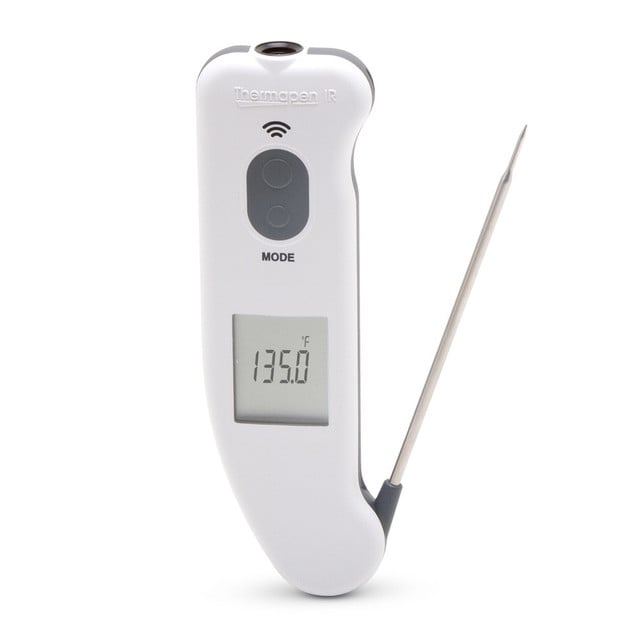
Explore this need in the finder →Thermapen IR is useful when a cooking session calls for two different questions: how hot is the surface, and what is happening inside the food? It puts a noncontact infrared sensor and a folding penetration probe in one handheld instrument. That can simplify a workstation, but the two readings remain fundamentally different. The infrared measurement cannot verify an internal food temperature, and its higher published ceiling does not increase the food probe's measurement range.
Two modes with a deliberate physical switch
With the probe closed, point the instrument at the target and hold the Scan button for infrared readings. Releasing the button holds the last reading for thirty seconds. Unfolding the probe changes to penetration measurement; insert the tip into the food and let the reading stabilize. Fold the needle fully into its retainer to turn that mode off, and do not force the hinge beyond 180 degrees.
This is a sensible sequence for checking a cooking surface before placing food, then checking the food internally later. It requires a separate action at each stage, with the user present. It does not provide two simultaneous food channels, a selected-temperature alarm or an unattended oven-monitoring routine. The instrument's minimum and maximum recall belongs to infrared mode and is lost after sleep or opening the probe. It should not be mistaken for a continuous internal-food log.
Surface scanning depends on the target
The infrared lens has a 5:1 distance-to-spot ratio. At five inches away it samples a zone approximately one inch across, so aiming farther away includes a larger area. Small targets require care to avoid mixing their temperature with surrounding material. The lens must remain clean, and the manual says infrared readings on shiny or polished metals are not recommended.
Emissivity defaults to 0.95 and can be adjusted from 0.10 to 1.00. That adjustment concerns how a surface emits infrared energy; it is not calibration trim for the penetration probe. An unfamiliar pan finish is therefore a reason to understand the scanning method, not to assume a precise number simply because the display has decimal places. The maker's infrared information sheet describes a ceiling around 662°F. That surface specification stays separate from the probe's 572°F internal measurement ceiling.
The food-checking function is a real penetration probe
For the probe, ThermoWorks specifies −58 to 572°F, with ±0.7°F accuracy through 392°F and ±1.8°F above that. Its two-to-three-second response is a manufacturer claim, not a result from our kitchen. The operating manual advises allowing the reading to stabilize. Use the tip in a representative internal location, keeping it away from a pan or another misleading contact point.
The current specification gives a reduced tip of 1.5 mm. Published needle length is less tidy: the current table gives 4.3 inches, while the linked information sheet calls it five inches. We retain that discrepancy rather than present one exact length as settled. If a particular insertion reach determines whether the tool will work in your setup, confirm it with the maker before choosing this model.
Controls support either hand, with some limits
The display automatically rotates in ninety-degree steps in both modes. The Mode and Scan buttons select Fahrenheit or Celsius and display resolution. The settings chosen in probe mode also apply to infrared measurements. The manual documents movement-based wake in probe mode, thirty-second automatic sleep and a longer timeout while changing settings.
Those are useful conveniences for someone repeatedly setting the tool down. An illuminated display and a user procedure for adjusting food-probe calibration were not established in the exact sources read. A calibration certificate and an adjustable infrared emissivity value do not fill either gap. A buyer who requires those features can compare the Thermapen ONE, which has explicit backlight and calibration-trim instructions.
Cleaning involves a delicate optical component
Two CR2032 batteries power the instrument, with a stated 1,000-hour life. The battery cover uses a retaining screw and both cells should be replaced with the correct polarity. No battery endurance or drop testing is claimed here. The body operating range is −4 to 122°F, so high-temperature readings do not make the whole instrument suitable for an oven.
The manual prescribes an antibacterial probe wipe for the instrument and a cotton swab with isopropyl alcohol specifically for the infrared lens, followed by complete drying. It separately warns that solvents can damage the case and screen. Keep those different cleaning instructions distinct. Its IP54 rating is not dishwasher permission, and exact machine-cleaning approval was not established.
Who benefits from the combined tool?
Choose Thermapen IR when surface scans and internal spot checks are both regular tasks and you understand the limitations of each. If you mostly probe food, the additional optical care and mode controls may not earn their place. If you need an oven probe and an alert, compare the ChefAlarm. Our local spot-check preset with both units and rotating numbers reflects the supported food-checking routine without importing infrared specifications into it.
Key details at a glance
| Documented spot-check use | Yes |
|---|---|
| Included food probes | 1 |
| Fahrenheit display | Yes |
| Celsius display | Yes |
| Rotating displayed characters | Yes |
| Measuring without batteries or charging | No |
| Documented food range minimum | -58°F |
| Documented food range maximum | 572°F |
| Probe-tip diameter | 1.5 mm |
| Manufacturer accuracy claim | For the penetration probe, the maker states ±0.7°F from −58 to 392°F and ±1.8°F from 392 to 572°F, with a two-to-three-second response claim. Infrared accuracy and its approximately 662°F ceiling are separate surface specifications. No independent response test is claimed; a response range is not collapsed into one universal time. |
| Power arrangement | Two CR2032 3 V cells. The maker specifies 1,000 hours of battery life. The manual documents thirty-second sleep, movement wake in probe mode and replacement of both cells through the screwed cover. No battery endurance trial or included-spare claim is made. |
| Care notes | The manual prescribes an antibacterial probe wipe for the instrument. Clean the delicate IR lens only with a cotton swab dipped in isopropyl alcohol and let it dry; solvents can damage the case and screen. IP54 does not establish dishwasher approval. Keep the body within its −4 to 122°F operating range. |
Use the exact model’s instructions for operating limits, supplied equipment and version differences.
Sources for this assessment
Find a thermometer for your cooking routine.
Compare the documented measuring setups, included equipment and features that matter to you.